About Me

My photo
I'm an Aussie who likes wandering all over the world but keeps coming back home to paradise and my family. If you are reading this on one of my travel blogs, I hope you enjoy reading them as much as I enjoyed creating them. If you are reading the Diabetes and weight loss blog - I hope it helps in your battle with the beast. Cheers, Alan
Showing posts with label Brazil. Show all posts

Saturday, July 10, 2010

Iguassu Falls - Movies


Travel Dates 26th and 27th April 2010.
This may take some time to load. If you are on dial-up, I'm sorry but it's probably not worth the wait.

I have rarely used the movie function on my Fuji F10, so I'm still a novice at movie making.

That shows in these clips; however, I hope that despite the amateur cameraman you get a sense of the awesome power and majesty of Iguassu Falls.

Edited May 2020. As blogger decided not to show the previous videos I have uploaded them again.

Brazil Side

Argentine Side


Cheers, Alan

Wednesday, July 07, 2010

Iguassu Falls, Brazil and Argentina

Also known as Iguazú Falls and Iguaçu Falls

Travel Dates 26th and 27th April 2010.
Please click on any picture to see the larger version.

The Iguassu Falls straddle the border between Brazil and Argentina, at the point just before the Iguassu River flows into the Paraná River, which is the border between both countries and Paraguay.

I had previously been to Niagara Falls in 2006, so there is a temptation to compare the two. It really isn’t right to do so. Both are absolutely wonderful spectacular examples of the power of nature; but each is different. Niagara is higher; Iguassu is wider and has more separate falls. Whether one has a greater volume of water passing over the falls than the other depends on the time of year and whether there is a drought or a heavy rainy season. Every cloud has a silver lining. Heavy rains in Peru and Brazil had led to damage to the rail lines to Machu Picchu and to the cog railway to Rio’s statue of Christ the Redeemer when I visited those places. But those same rains resulted in unusually high water levels in the Iguassu River and a massive volume of water over the Iguassu Falls when I was there.


If you are into details such as widths, heights, flows and all that, there are more here on Wiki.

I visited both sides. Both countries have declared the falls and the surrounding district as National Parks and both are World Heritage listed. Local buses service the falls on both sides of the river. On the Brazilian side the 120 bus takes you, via the airport, to the main tourist centre and your Park entry ticket includes another bus to the various stops for walks and hotels. On the Argentine side, after you reach the tourist centre, the transportation in the Park is a tourist train. I took that from the entry to the Falls but I walked back. It is only a short walk to return on foot to the tourist centre, but try not to tread on the locals.


Although getting there has similarities, the experience is quite different on the two sides.

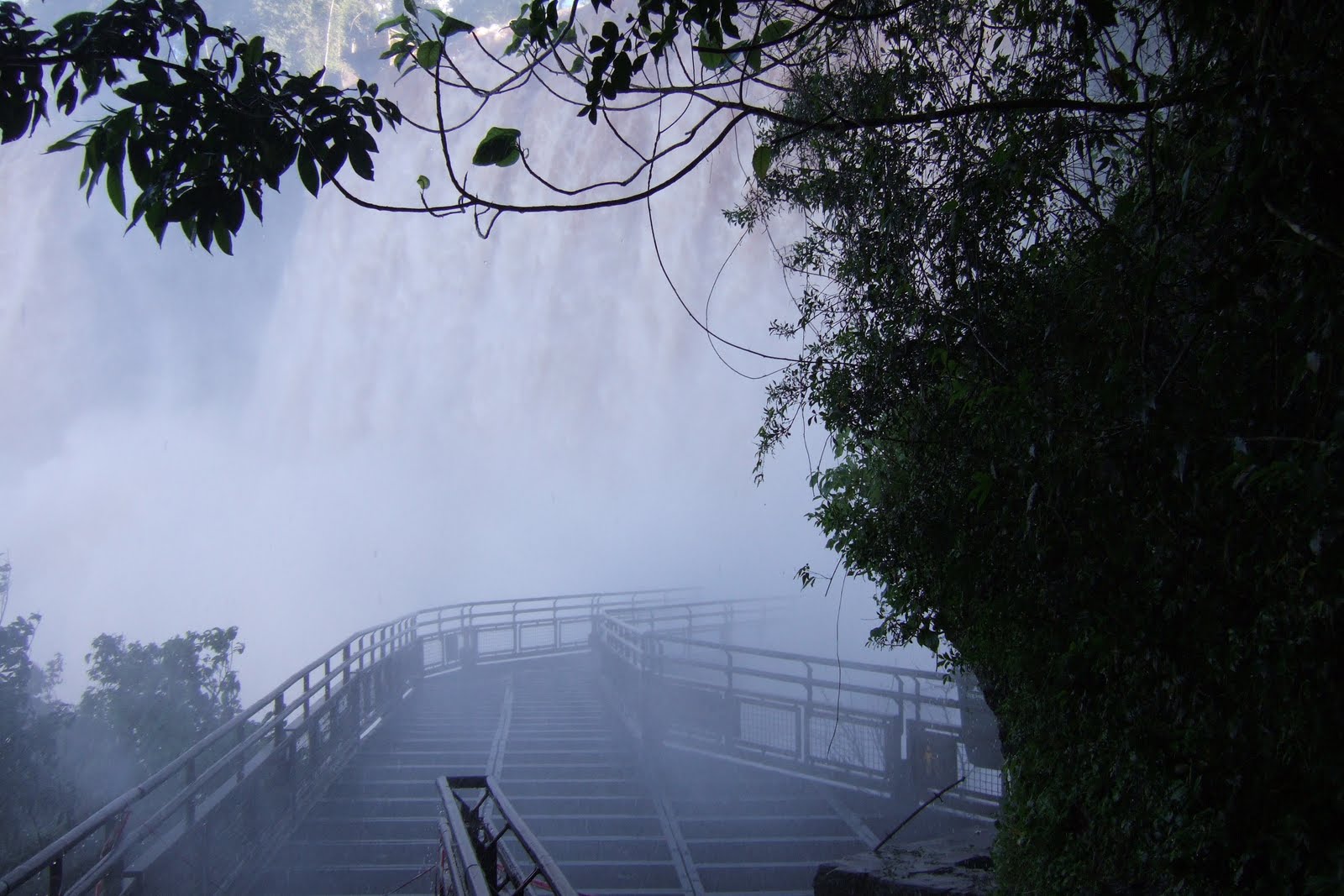
On the Brazilian side a walkway has been constructed with spectacular views of the main falls at the Devil’s Throat and views across the river to the Argentine Falls. The walk is a couple of kilometers long with several stops for photos or just to watch the awe-inspiring display. The thunderous roar of the descending water is continuous as you walk towards the Devil’s Throat, but becomes overwhelming when you reach it.

You are able to get much closer to the falls than you can at Niagara where the only way to get really close is on the Maid of the Mist. On the Brazilian side, when the water level is lower, tourists are allowed to walk out on this platform to experience the full majesty of the rushing water. However, because of the high levels the authorities had closed it and taken the opportunity to do some maintenance.


On the Argentine side there are many smaller falls and also many more walkways between and over them. By smaller, I am comparing with the Devil’s Throat; they are still massive when compared to other waterfalls.


It is a fascinating experience, walking or standing just a meter or two above the lip of a mighty waterfall and watching the water rush under the catwalk and drop directly down below your feet.


Also, on the Argentine side, you become aware that areas that look like typical jungle forests from a distance are actually covered with water up to a meter deep rushing along between the trees in its haste to drop over the edge of the cliffs. I wondered why the trees had not washed away years ago. They must have very tenacious root systems.

On both sides I was impressed by the engineering of the walkways. I assume they must have built them during a drought, because there is no way they could build them when the water levels are as high as they are at the moment.


I’ll follow this post with my first experiment in uploading a few movies of the falls.


Cheers, Alan

Thursday, June 24, 2010

Foz do Iguaçu and Puerto Iguazú


Iguassu Falls from the GOL 737

Travel Dates 25th-28th April 2010.
Please click on any picture to see the larger version.

I've been delayed by many things since I returned from South America, but I have decided to make the time to complete the record. My next post will be devoted to the mighty Iguassu Falls, with lots of pictures from both sides. This preliminary post is about the towns and travel in the Iguassu district.

The flight from Rio to Foz do Iguaçu was uneventful. I was pleasantly surprised at the quality of the GOL service, which I used from Sao Paulo to Rio and Rio to Foz do Iguaçu. The only significant annoyance was their tendency to change departure gates with no warning apart from a change on the TV screens. Watch those screens if you decide to use GOL.

I’ll use the English spelling for Iguassu Falls, just to add to the confusion. Similar to Niagara Falls being on a river which forms the border between Canada and the USA, the Iguassu River forms the border between Brazil and Argentina. Consequently the correct spelling depends on which side of the falls you are. There are twin towns straddling the falls, both very dependent on the tourist income they attract.

Foz do Iguaçu is the Brazilian city. It has a population of about 300,000 and is also the regional centre. After some pretty bad hostel and hotel experiences in Peru, Ecuador and Rio the Pousada El Shaddai hostel was a pleasant change. Nothing flash, but the beds were comfortable, the bathroom was clean and the staff were excellent with good advice on transport options. Apart from a need to change rooms when a leak appeared in my window when the heavens opened, my two nights there were pleasant.


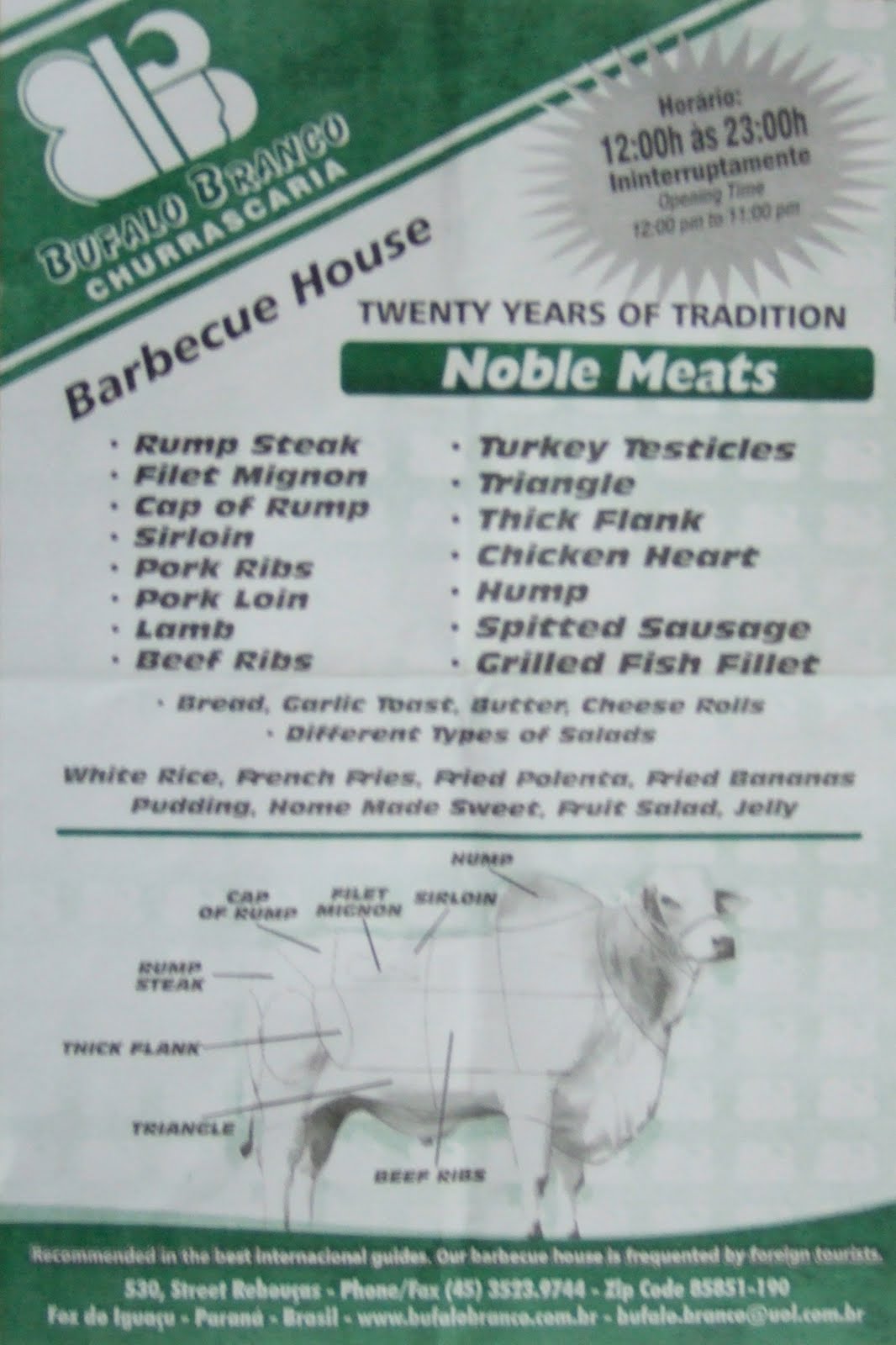
On their recommendation I splurged on a restaurant a little above my usual budget. That led to the most interesting dining experience of my trip. Just a block from the hostel is the Bufalo Branco Churascaria. I had looked unsuccessfully for places like this in Rio, and later I was equally unsuccessful in Buenos Aires. The menu is a little misleading for those not used to the Churascaria method. I arrived about 6:30 pm; I later realised I was far too early. The lady at the entry tried to explain the system, but I did not fully understand it. The price was fixed at 43 Reais, about AU$25 at the time. This included free choice from both the salad bar and dessert table. So I made my selections and sat down and waited for service. And waited...and waited...


I had forgotten that both the Brazilians and the Argentinians consider 8pm early for dinner, so at 6:30 I was the lone diner. I started to get annoyed, but I sipped my excellent large glass of red house wine and nibbled on my salads and kept waiting. Eventually, a couple arrived, then another, then a few businessmen. Finally, nearly an hour after I arrived, a waiter appeared at my table with a lump of hot barbecued meat on a sword-like skewer and asked me to indicate which part I would like sliced from it. He showed me on the menu diagram that it was from the rump region of the steer. By selecting my own slice I could choose from the charred outer surface or the bleeding rare meat surrounding the skewer to anything between; I chose medium-rare. It was superb – tender, juicy and delicious. But I was a little surprised at the small portion size. I should not have pre-judged.

I noticed that he took that same skewer from table to table, slicing cuts on request for the diners. I had barely finished that small portion when he was back with another skewer and a different cut of meat; before I finished that he was back with the pork ribs, then the lamb, then another different cut of beef, then some delicious barbecued fish. I started visualising the Fantasia scene from the sorcerer’s apprentice, with a never-ending and constantly increasing stream of meat arriving.

Eventually, after I had skipped a few choices and slowed down considerably I got the message across that I was full. It seemed that I stopped before we got to the Turkey Testicles. Of course, I still managed to find space for a small dessert. In hindsight I realise now that they needed a minimum number of diners in the place before they started serving and that was why I had the long wait after arrival.

All of the food was superb. It was a magical dining experience for me despite the misunderstandings at the start. For the diabetics reading here, my peak post-prandial test was excellent.

The hostel was a short walk from down-town Foz do Iguaçu. The town and its people were laid-back and pleasant; I wandered around all of down-town and many of the back-streets without ever feeling insecure. I only ate at the Bufalo Branco once; I found that their house wine was unusually good when I tried the local red wine at other restaurants – the house reds in those varied from terrible to paint stripper. I don’t know what they make the regional red wine from, but I have doubts that it is grapes.


On both sides of the border I used the local bus system to go to the Iguassu Falls. The buses are frequent, clean and cheap. On the Brazilian side the same bus services the airport and is a cheap way of going from the airport to the city. Both towns have a large central bus station near down-town with buses to local, regional and international destinations.


On the Argentine side of the river is Puerto Iguazú, smaller, with a population a little over 30,000, and more tourist-oriented than Foz do Iguaçu. Both towns have their own airport; this had an advantage for me because it meant I arrived from Rio de Janeiro and departed to Buenos Aires on internal domestic flights in both cases. That simplified immigration procedures and may have also saved me some taxes.

The third city in the district is Ciudad del Este in Paraguay, on the Paraná River which the Iguassu River flows into. The Paraná River, which is second only to the Amazon in size in South America, forms a border between both Argentina and Brazil with Paraguay. I had not allowed enough time on my itinerary to visit the city or the associated Itaipu Dam and hydro facility; if I was planning the trip again I would make the time. It is a major free-trade centre and the locals from Foz do Iguaçu and Puerto Iguazú appear to travel there regularly for shopping.

This was the first time in my travels that I have used local buses to cross a border. It became a little confusing. I took a short walk from the hostel and caught the bus to Puerto Iguazú at a local stop. That took me to the border; I was advised by the driver to hold on to my ticket because the bus would not wait but the next bus would let me continue on the Argentine side of the border. After I followed the short queues through police and immigration I waited with some Canadians at the bus stop for that next bus. We declined two local buses that stopped because we had pre-paid our fares but our bus never arrived. Eventually we gave up waiting and took the third local bus that stopped. When I look back on that, I can’t believe I wasted nearly an hour to save 3 Reais.

I was unimpressed with Puerto Iguazú. Compared to Foz do Iguaçu it was smaller, dirtier and more oriented to separating the tourists from their dollars. I stored my bags at the bus station for 8 pesos and went walking to find a hotel. I tried half a dozen, plus some hostels and found that all seemed over-priced for the quality provided. Eventually I chose the Hotel Alexander, which was 3* and reasonably priced at 150 pesos (about AU$44), probably because it was closing the following day for major renovations. I suspect that was the reason for a rather grumpy and uncommunicative front desk manager. However, it was a comfortable bed and a reasonable room when compared to the opposition.

I also felt a bit less comfortable wandering the streets at night in Foz do Iguaçu. It was nothing tangible; just a feeling that I seem to have developed over the years of my wanders around the world, or even from my years driving cabs on the night shift. Little things, like the attitudes displayed by youths, or the tidiness and condition of houses and yards, or the prevalence of high walls, barred windows and security systems on better homes, or the surliness of cab drivers. Suffice to say I took a bit more care and restricted my after-sunset walking.

Later, in Buenos Aires, I realised I had left my debit card in an ATM machine in Puerto Iguazú. That was my own silly mistake; it happened to be the first card-swallowing ATM I had encountered on the trip and I was distracted while collecting the cash, so I failed to press the button to indicate I had finished and never retrieved the card. The good news is that it was not mis-used before I cancelled it. I always carry at least one back-up card on a different account, so the loss was only an inconvenience, not a disaster.

Next, the Falls.
Tuesday, May 04, 2010

Rio de Janeiro


Ipanema at dusk.

Travel Dates 20th-25th April 2010.
Please click on any picture to see the larger version.

I did not do all the usual tourist things in Rio; I used it mainly as a pleasant place to rest and recuperate after the Galapagos. Which was just as well because not all the traditional visits were available at the time.

At the same time that rain in Peru washed out the Machu Picchu rail line, rain in Rio washed out the cog railway line to the famous statue of Christ the Redeemer overlooking the city. Even if I used alternative means to get there the statue was completely covered by scaffolding for renovation.
My travel from Quito was one of the more tiring nights of the trip. I departed at 8:40 pm with a two-hour flight to Lima, followed at 1am by a five-hour flight to Sao Paulo and, after immigration formalities, another flight to Rio arriving at 12:30 pm Rio time (there is a two-hour difference between Quito and Rio). I was ready for bed on arrival.
Unfortunately I was too tired to go to the other traditional lookout on Sugarloaf mountain by the cable car on the first day and the weather was uncooperatively windy or hazy on the other two days.


But that was not a major loss to me. I enjoyed other things. I wandered, mainly on foot, around Copacabana, Ipanema, down-town and over the bay in Niterói looking at the people, the beaches and the shops and getting a feel for the city.

In Copacabana and Ipanema the people, especially their dress, reminded me of Sydney's Manly Corso.


There are few other places in the world (apart from my own hometown) where no-one raises an eyebrow seeing men and women walking past in costumes ranging from high-fashion business suits to scanty swimsuits such as budgie-smugglers (ask an Aussie to translate that) or thongs (not the ones on feet).


The beaches are just as I expected – golden sand, gentle surf and overpopulated – but so are Manly and Bondi so I can't complain about that. I must admit it was hard to get the tune from “Tall and tan and young and lovely” out of my head but I rarely saw any girls who would have qualified for the song. Maybe I'm just getting more difficult to please in my '60s...

I will use Brazilian Reais when I mention prices; approximate equivalents are R$10 = AU$6 = US$5.50.

I tried most of the public transport options in Rio. The underground Metro trains were useful to get from Copacabana to downtown and cost R$2.80 per trip regardless of distance. The only problem with the metro is finding the station – there seems to be little advertising at the entrance apart from a sign showing hours of operation – and the very long distance from the entrances to the actual platforms.


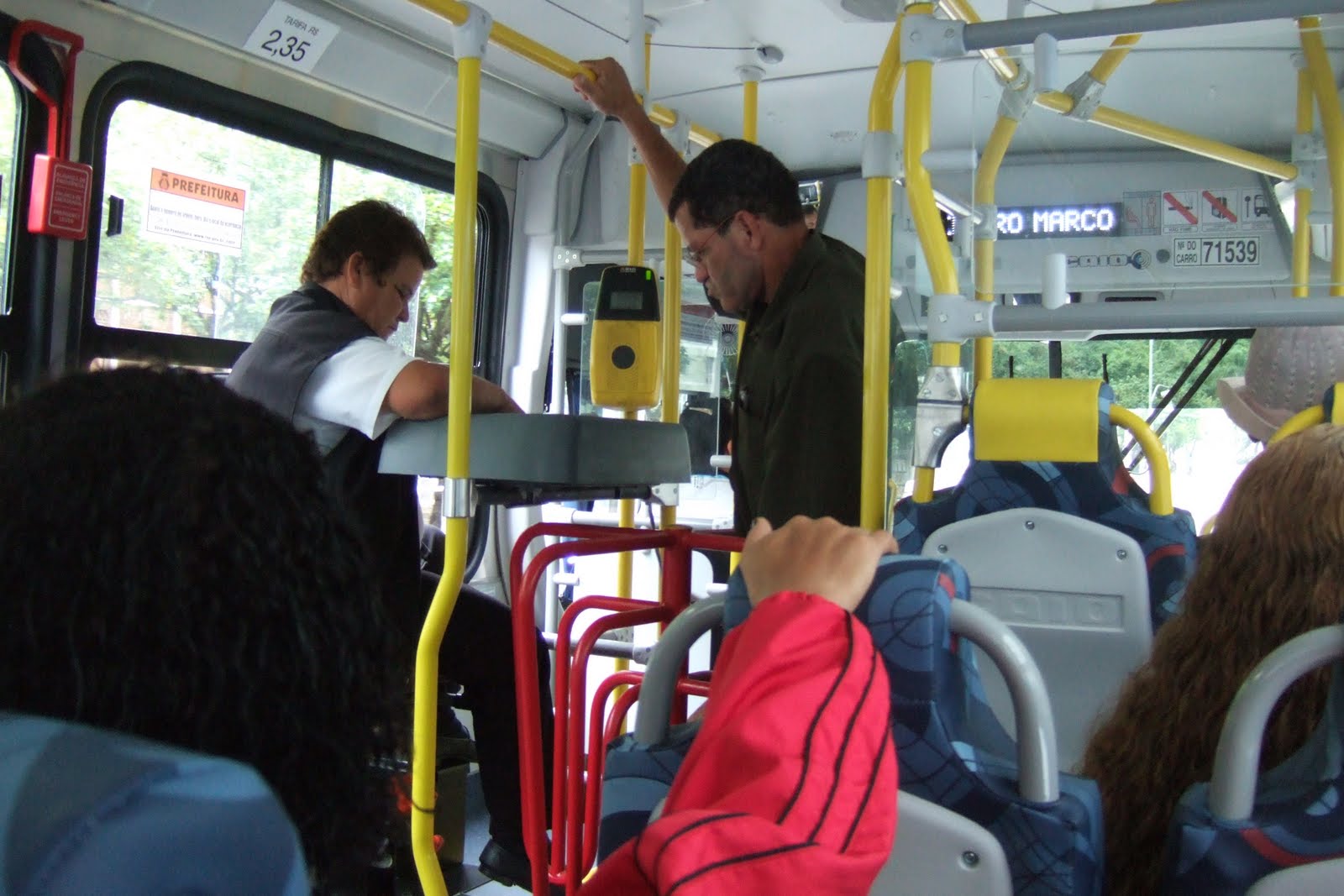
The local buses all seemed to charge R$2.35 regardless of your trip length. The drivers of the two I used were both trained at the Bob Newhart bus driver's academy. On the first bus I got up from my seat and pressed the button to get off at the next stop. Immediately I found I was hurtling up the aisle to the front of the bus as the driver rammed his foot on the brake. I was stopped abruptly when I reached the turnstile. Nobody looked surprised. Actually, I had never seen buses with turnstiles before; I found them in all the buses in Brazil, including Foz do Iguaçu. On the next bus I had learned my lesson and stayed seated after pressing the button. But on that bus I already had white knuckles from gripping the hand-holds while we hurtled down the roads from Ipanema to Copacabana. Who needs the excitement of a cable car or a roller-coaster when you can get the same adrenalin rush for R$2.35 on a Rio bus?

While walking around downtown I came across a ferry terminal. The ferry for Rio's sister city over the bay, Niterói, was just leaving. When in Sydney I enjoy wandering around on the ferries, so I decided to take the trip. I recommend it; the journey is pleasant and Niterói is a little different in style to Rio. There was a street market which appeared to be permanent, lots of restaurants and shops which appeared to be slightly cheaper than Rio, and almost no tourists apart from me. The long bridge in the distance goes to the same place. It was a warm day: 37C translates to 100F.


As a traveller who has fairly strict dietary needs I loved Rio. One of the most common forms of restaurant are a form of buffet or smorgasbord which charge by weight. The quality varies a little, but most are excellent. I could choose exactly what I wanted from a wide range of choices of meats, fish, prawns (shrimp), vegetables in many styles, salads, pastas and desserts. My usual lunch cost between R$8 and R$12 with dinner a few R$ more. Most also had reasonable quality “house red” or vinho vermelho by the glass for about R$5-8.


Beer is available everywhere and is fairly cheap. It took me a while to realise that “chopp” is not a cut of meat but a draught beer, usually R$3-5. A very pleasant way to spend a half-hour sitting by the sand on Copacabana beach.

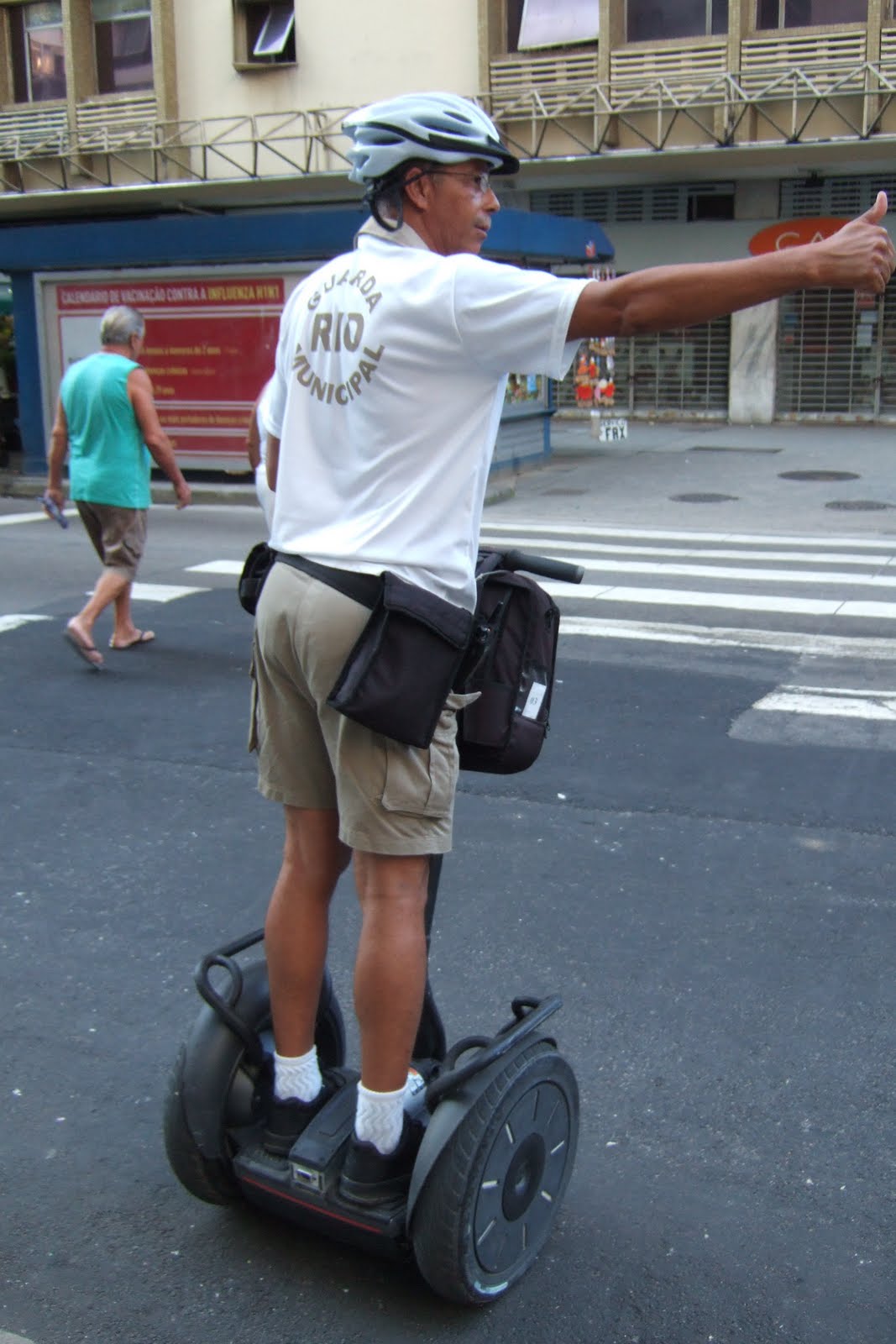
One of the odd things I noticed in Brazil, both in Rio and Foz do Iguaçu, was the number of specialist dental surgeries. They are big business here; maybe there is something about the local cuisine or genes that leads to a higher demand. This operator includes a mobile service. So does this cop.


On Saturday afternoon I found another street market not far from downtown Rio. The street cuisine looked interesting but I wasn't brave enough to try it.


After browsing through the market for a while I decided to walk to the Largo de Carioca to go for a ride on the Bonde de Santa Teresa. I thought I knew where that was so I started walking, but I was diverted by a park with it's downtown rainforest.


After I left the park I walked on for a while until my feet were getting sore so I hailed a cab. Once the driver and I had worked out where I wanted to go he proceeded to re-trace my steps and took me an equal distance past my starting point in the opposite direction. So much for my excellent sense of direction.

The tram was fun, but I had to wait an hour and a half in the queue to board it. The fare is only R$0.60 but it's capacity is limited which is the reason for the long delay.


The tram goes over a track high above the roads near the start; the local youths seemed to be having a macho competition to see who could be more daring hanging by one hand with one foot on the running board as we passed over that. It was probably more dangerous when we returned to the roads and were passed closely by buses.


I'll close with a few more shots taken from the tram. Despite some hotel problems (see my review of the Astoria Copacabana) I enjoyed Rio. Good food, nice people and a wonderful place to relax.


Cheers, Alan