
About Me

My photo
I'm an Aussie who likes wandering all over the world but keeps coming back home to paradise and my family. If you are reading this on one of my travel blogs, I hope you enjoy reading them as much as I enjoyed creating them. If you are reading the Diabetes and weight loss blog - I hope it helps in your battle with the beast. Cheers, Alan
Showing posts with label South America. Show all posts

Wednesday, January 19, 2011

BA to Sydney via the Edge of Antarctica


Please click on any picture to see the larger version.
Travel Date 5th-6th May 2010.

I don't post a lot of pictures taken through the aircraft portholes, but these are a little different to the usual.

The flight from Buenos Aires to Sydney appears short on paper. Take-off is at 2 pm, arrival at 5:50 pm. But that is deceptive because it is actually fifteen hours long, crossing many time zones and the date-line. The flight stewards treat it like a night flight, with most people closing the window covers and settling down for a snooze shortly after take-off. But not me.

If you look at a standard Mercator's projection map of the world you might think a flight from BA to Sydney heads straight across the Pacific Ocean, crossing Chile and heading for Sydney via Tahiti and the top of New Zealand. But that is also deceptive. In fact, the shortest route heads straight down the east coast of Argentina, passing over Patagonia and Tierra Del Fuego and skirting the edge of Antarctica.

I was glued to the window, fascinated by the terrain we passed over. This is some of the most inhospitable land in the world. And also some of the most inhospitable seas. The channels between the islands of Tierra Del Fuego hide the remains of many ships and their crews from the sail era.


Then the skies slowly changed colour; it was like flying through a pastel rainbow.


Slowly, the sea turned from the blue of the deep ocean to the ice-blue of the great ice-sheets of the Antarctic fringe, dotted with icebergs. The size of these icebergs is so enormous it is difficult to describe. At one stage we passed over a ship that was not far from a berg. It was like a speck; just a dot compared to the iceberg near it. Unfortunately, I missed that photo.


Each berg had a corresponding ice-free lake in its lee. I think it is created by the currents as the berg becomes an ice-breaker, pushing against the surrounding ice sheet and leaving clear sea in its wake.
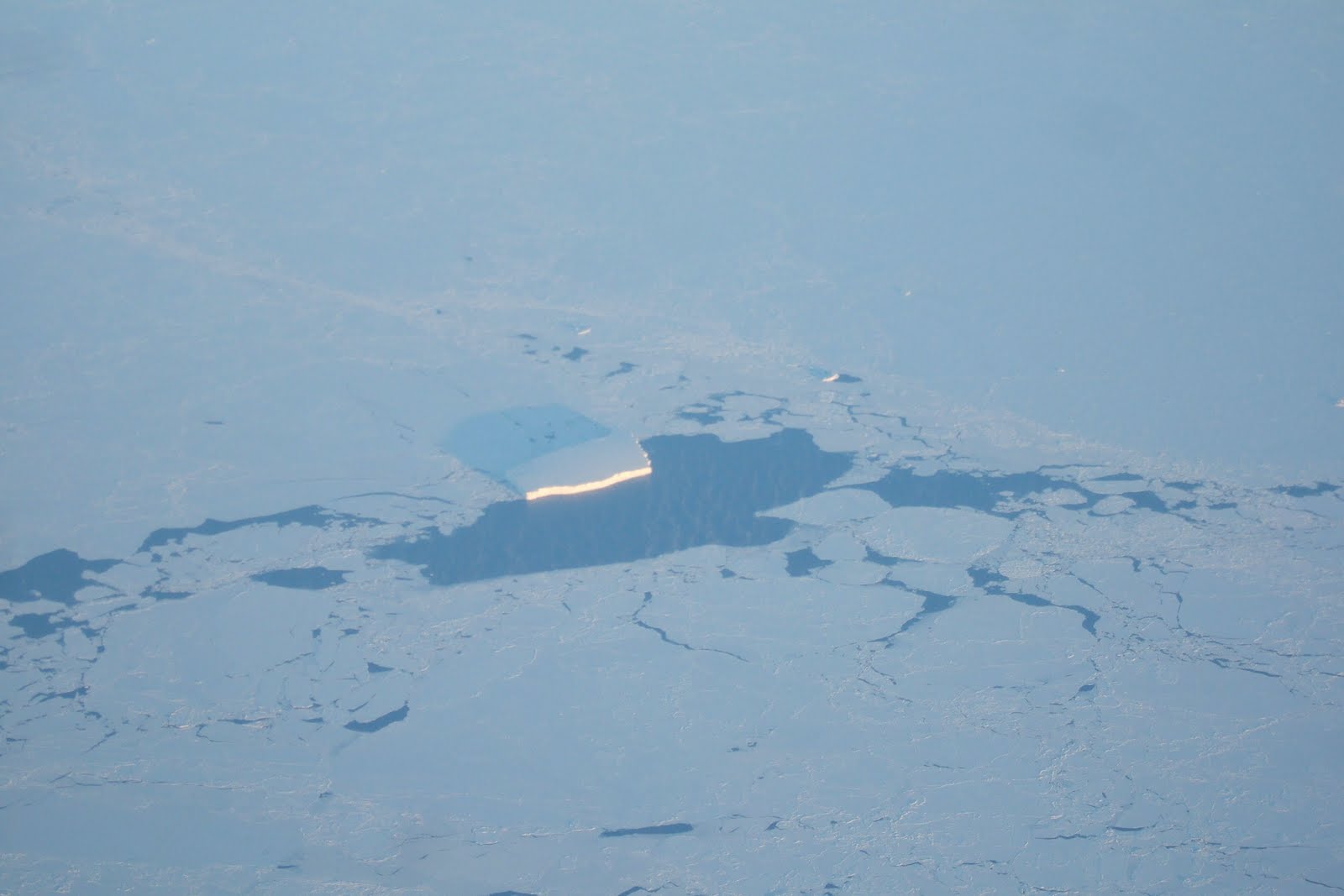


Most people hate long flights. I must admit I enjoyed this one. It helped that, as usual, the Qantas service and food was excellent.

And so the journey around South America ended. I had a fascinating time; some day I may return. But there is still so much of the world to see...

Cheers, Alan

Friday, January 14, 2011

Buenos Aires, Palacio Barolo


Please click on any picture to see the larger version.
Travel Date May 2010.

One of the things I enjoy most when I arrive in a new city is to wander by foot, bus and rail looking at the architecture and style of the suburbs and the city. As an Australian one of the first things that struck me was the similarity in style to some of the inner suburbs and central city area of Melbourne. Buenos Aires is described in some of the guide books as the Paris of the South. It is easy to see why; the French style appears subtly in many of the inner-city Barrios. But it is more than that, with a strong Spanish accent and occasional Italian influences.

The Palacio Barolo is one of the more interesting buildings in the city. It was designed by an Italian architect, Mario Palanti, who was commissioned by Luis Barolo who was an Italian immigrant who had made his fortune in the textile industry in Argentina.


Barolo was also a major fan of the medieval Italian author Dante Alighieri, commonly known just as Dante and his greatest work "The Divine Comedy". The architect was instructed to design the building to relate in many different ways to Dante's work; some are obvious, but many are subtle.

The Dante influence is inextricably part of the building. The Divine Comedy has 22 stanzas; the building has 22 floors. The basement, entrance and ground floor represent hell, with a mosaic and medallions on the floor representing flames. There are also lamps in the mouths of grotesque dragons; male to the west and female to the east.


Floors 1 through 14 represent purgatory and 15 through 22 represent heaven, crowned by the lighthouse representing God and salvation.

There are 100 cantos represented by the height of 100 meters. I was told by the guide that there are many more subtle representations of Dante's work in the building but as I'm not a student of Dante I missed those. The foundations apparently represent a golden ratio.


On a patriotic note, Barolo had the building designed so that on July 9, Argentine Independence Day, at 7:45pm the Southern Cross directly lines up over the tower. Barolo wanted Dante's ashes interred in the building, but that never happened and a statue of Dante designed for that purpose disappeared in the turmoil at the end of the Perón era in 1955.

The building was completed in 1923 after four years construction. Barolo used three floors for himself and let the remainder. He had his own personal secret elevator to his apartments, those elevators have now been sealed.


It was the tallest building in all of South America until 1935 and its lighthouse had a practical use guiding vessels on the broad expanse of the River Plate, or Rio de la Plata. The views of BA from the upper floors and from the lighthouse are magnificent. Unfortunately the smog was a bit heavy on the day, but I hope these photos give an idea of the view.


Optics experts will notice that I turned the reflection from the lighthouse mirror upside-down to show the cameraman :)

I went on the official tour, run by the builder's grandson which finished in the original owner's office.


I recommend the tour as a fascinating and interesting way to spend a few hours to anyone visiting Buenos Aires.

Cheers, Alan

Sunday, January 09, 2011

Buenos Aires La Recoleta


Please click on any picture to see the larger version.
Travel Date 29th April 2010.

When I planned the trip to Buenos Aires I was able to find an excellent apartment in the Recoleta Barrio, or district.


The Recoleta Barrio is famous for two main reasons. In the 1730s the monastic Order of Augustinian Recollects, or Recoletas, established a convent and church in the area. Ninety years later their convent was disbanded but the convent's garden became a public cemetery and the church continued as Our Lady of Pilar. The area at that time was undeveloped.

After the Yellow Fever outbreak in the 1870s the Recoleta neighbourhood became the favoured location for the wealthy as they fled from the older established but fever-ridden barrios of San Telmo and Montserrat to the south. Consequently the cemetery became theirs and very exclusive. Most of the plots are now owned by families, although some have been publicly purchased for the heroes of the nation. The Barrio is now one of the most exclusive in the city.

All the vaults are above ground and some of the coffins are clearly exposed on shelves in the vaults. Surprisingly, the air is fresh and clean with no bad odours, or as fresh and clean as you can get in the smog of Buenos Aires.


There are 4800 plots; the truly wealthy have a single plot for a single person, or go even further and erect elaborate memorials to their memory; others are more efficient, managing to inter many in the same small plot. By far the most visited plot is that of Eva Peron and her family.


Most plots are well-cared for by staff paid by the families, but some have fallen into disrepair.


The cemetery has become a major tourist attraction of the city, but when I went it was uncrowded and the visitors were quiet and respectful.

I found it to be a very interesting place to spend a couple of hours, a restful spot away from the bustle and traffic of BA.

Cheers, Alan

Monday, July 26, 2010

Buenos Aires, Argentina


Please click on any picture to see the larger version.
Travel Dates 28th April - 5th May 2010.
Also see On My Way Again for my first day in BA.


The first thing that struck me about Buenos Aires as the plane circled to land was the size of the city. And the smog.

I planned to end my South American trip with a week in Buenos Aires partly because of Australian quarantine restrictions. As I cannot have a yellow fever vaccination and I had spent a few days in the YF-endemic Iguassu district there was a possibility that I would have to spend six days in quarantine if I had gone directly home. In any case, it was a lovely, enjoyable and relaxing city to spend a week in.

BA is sometimes called "The Paris of the South". There were Parisian influences obvious in some buildings and street styles, but I found BA was also very similar in many ways to the inner suburbs and central business district of Melbourne. The exchange rate meant that restaurants and transport were cheap by Australian standards. 100 Argentine pesos is about AU$28 and US$25; I ate very well for under 40 pesos most nights.

When I arrived at my flat in Recolata I noticed that the district, or Barrio, was wall-to-wall apartment blocks apart from the commercial centre, generally varying from eight to fifteen storeys high with occasional towers of 20 storeys or more. What surprised me was that, unlike Melbourne or Sydney, those multi-storey apartments continued out into the outer suburbs. Later, I took the Subte Linea A out to San José de Flores, many kilometres out of the centre and found the same style of cheek-by-jowl multi-storey apartment blocks out there. The first picture is my street in Recoleta, the second is in San José de Flores.


I always considered Australia to be over-urbanised, with more than half our population living in the principal cities of Sydney, Melbourne, Brisbane, Adelaide and Perth. But Argentina makes us look almost bucolic by comparison, with more than half the population of over 36 million living in Buenos Aires and its suburbs. From my own observation a significant proportion of them appear to live in urban apartments. There are probably suburbs with individual houses on quarter-acre blocks, but I didn’t see any.

If you intend visiting this city for more than a few days I suggest renting an apartment instead of a hotel. For me there was the added advantage of being able to cook my own breakfast, but if I had not chosen to do that there were lots of nearby cafés and restaurants. I used BA Stays; the apartment was excellent and perfectly located and far cheaper than a hotel. I wrote a longer report on BA Stays here: Buenos Aires Stay apartment rental.


My Recoleta apartment was about five blocks from the Agüero station on Linea D and only a couple of blocks from the multitude of buses proceeding in both directions along Avenue General las Heras. I rarely needed a cab, but when I did I found them to be inexpensive. If you intend using buses when you visit this city go to any news-stand and buy a current copy of the Guia "T" de Bolsillo, the guide to buses. It fitted easily in my pocket and was easy to understand despite being in Spanish. It is well laid out and was invaluable in planning routes to see the city.


I did the usual tourist things such as seeing the main buildings, parks and attractions. That included the Obelisk and, of course, the Recoleta Cemetery which I’ll describe in the next post, but mostly I took life easy and wandered at my own pace on foot, in buses and on the Subte.

The regional railway lines have almost all disappeared, so the enormous rail terminus now appears to provide for infrequent trains to Villa Rosa. The city Cathedral is next door.


I like seeing the architectural styles and differences in the cities I visit. These are just a couple of examples; later I will write a separate post on a special building, the Palacio Barolo.


The Subte is the city's metro; five main lines, all underground, covering a significant proportion of the inner city but limited in the outer regions. All of the lines are separate but your ticket allows you to transfer between lines at the stations where they pass over or under each other. For more detail see this excellent description: Buenos Aires Subte. They have their own division of the Police Force - the Division Subterraneous.


Subte Linea A line is special. The other lines are reasonably modern, but the Linea A is a step back in time to the era of wooden carriages built and maintained by craftsmen. I believe that it is deliberately maintained in the old style and that there are no plans to modernize it; at least I hope so. I took it to the last stop, then walked around San José de Flores and spent a pleasant afternoon in the cafés and shops before returning on buses to see a different view of the suburbs.

I spent a day in Palermo, walking the streets and visiting the cafés and parks, and another in the San Telmo and Constitucion barrios.


Interesting sculptures appeared without fanfare in some of the streets.


All the barrios were slightly different in their architecture and style, all were interesting. Many of the parks had market stalls, some were surrounded by cafés and some had free public tango displays.


I was warned by the locals to avoid Boca at the time I was there; apparently there were security problems at the time. However, I had no problems in the other areas or downtown no matter where or when I wandered. In hindsight I regret not going to Boca.

There was some graffiti, but not a lot by the standards of other major cities. I noticed that Las Malvinas was often the subject of the graffiti. It is a war that may have diminished in UK memories and been forgotten by the rest of the world - but the subject is very much alive in Buenos Aires. This memorial is in the Plaza San Martin.


On the other hand, some of the veterans of that war feel very much aggrieved at their treatment by the government and have camped for a couple of years in the Plaza de Mayo in central downtown. The soldiers who served on Argentine soil and did not actually face the British in battle received no recognition or benefits and they feel rather strongly about it. The government tries to ignore them - but is taking no chances. This was one of three armoured vehicles close to the protesters camp. More details are here and here. Recent oil discoveries near the Falklands have also rekindled interest.


While I was in the Plaza de Mayo there was a crew taking some fashion pictures. Love the shoes and the hat. The things women do to get noticed...Actually, I would have noticed this lady even if she hadn't been wearing the shoes or the hat. Or anything at all.

The food in BA was excellent; I didn't keep a record of the restaurants I tried, because I ate wherever I happened to be at the time, but nearly all had a good range on the menu and the food was tasty and properly cooked. Wines were generally good, but sometimes were more expensive than the food.


For lunches I often had food from small fast-food diners. There were several that specialised in choripan and morcipan. Choripan is a large chorizo sausage on a white-bread bun slathered liberally with a choice of salsas; delicious. Morcipan is a blood sausage served similarly. Unfortunately the one I tried was almost liquid in its interior; nothing like a UK black pudding. I'm afraid it will be the last one I try. Many of the Choripan restaurants also had various cuts of meat available on the Asado grill to be served in a similar way.

One of the unique businesses in Buenos Aires is dog-walking. I know other cities have dog-walkers - but nothing like these. It is a city of apartment dwellers who, for some unfathomable reason, like to own medium to large dogs that must be walked in the fresh air daily. Apparently the walkers, or paseaperros, get paid by the month on a per-dog basis. The more dogs you walk - the more money you make. I often saw walkers with packs of 20 or more, but I never seemed to have the camera ready at those times so this is just a small pack.


As a friend of mine used to say, if you're not the lead dog the view is the same. Despite tremendous differences in sizes and breeds I never saw any of the dogs misbehave or act aggressively to anyone or other dogs. Also, despite the laws on picking up after the dogs, I found it was very wise to watch where I stepped on the streets of Buenos Aires.

I thoroughly enjoyed my week in BA and I'd love to go back some day.

Cheers, Alan