About Me

My photo
I'm an Aussie who likes wandering all over the world but keeps coming back home to paradise and my family. If you are reading this on one of my travel blogs, I hope you enjoy reading them as much as I enjoyed creating them. If you are reading the Diabetes and weight loss blog - I hope it helps in your battle with the beast. Cheers, Alan
Showing posts with label Cambodia and Thailand. Show all posts

Thursday, May 29, 2008

Bayon and Angkor Thom


Travel Date 9th March 2008
Click on any picture to see a large version.

I just realised that I had slipped back to Bangkok without mentioning my afternoon wanderings through Angkor Thom and the Bayon.


Possibly that's because, after all the walking I did in Angkor Wat I spent most of the afternoon in the back of the tuk-tuk, travelling the lazy way from site to site.


To be honest, my feet were killing me; I had bought good walking shoes for the trip but I should have spent a little longer breaking them in before the trip.

However, I did get out to wander around the Bayon.


Have you ever felt you were being watched? The Khmers certainly must have back in the days of Jayavarman VII. Talk about Big Brother. I'll explain why in a minute, but first a brief history.

The Bayon is a Buddhist temple in the centre of Angkor Thom, next to Angkor Wat. Angkor Thom was the walled capital city of the Khmer Empire at one of it's peaks, from about 1181 AD when Jayavarman VII commenced building both the city and the Bayon. It is one of the latest structures built in the Angkor complex and one of the few Buddhist temples. Angkor Wat was built earlier and was originally a Hindu complex, although later Buddhist influences appeared.


The Bayon was built as a Mahayana Buddhist temple originally, and later became a Theravada Buddhist temple. However, the influences of the earlier Hindu sculptors also infiltrate the bas reliefs and parts of the structure. Even some Chinese faces appear as warriors in the bas reliefs.

The most fascinating aspect of the Bayon is the more than 200 giant faces watching you wherever you go. They even appear on outbuildings and near the great walls and gates. There are several theories about the faces. Some say they are a representation of the Mahayana bodhisattva Avalokitesvara. However, they bear a striking likeness to the images left of Jayavarman VII, so I tend to go along with those that believe he used his face to be the face of the bodhisattva deliberately to extend and reinforce the devaraja cult of the king as a god, first established by the past rulers who built Hindu Angkor Wat.


But, wherever you go, he is watching. The story is that every face sees some distant part of the Empire, so all of his subjects knew that the god-king was watching.
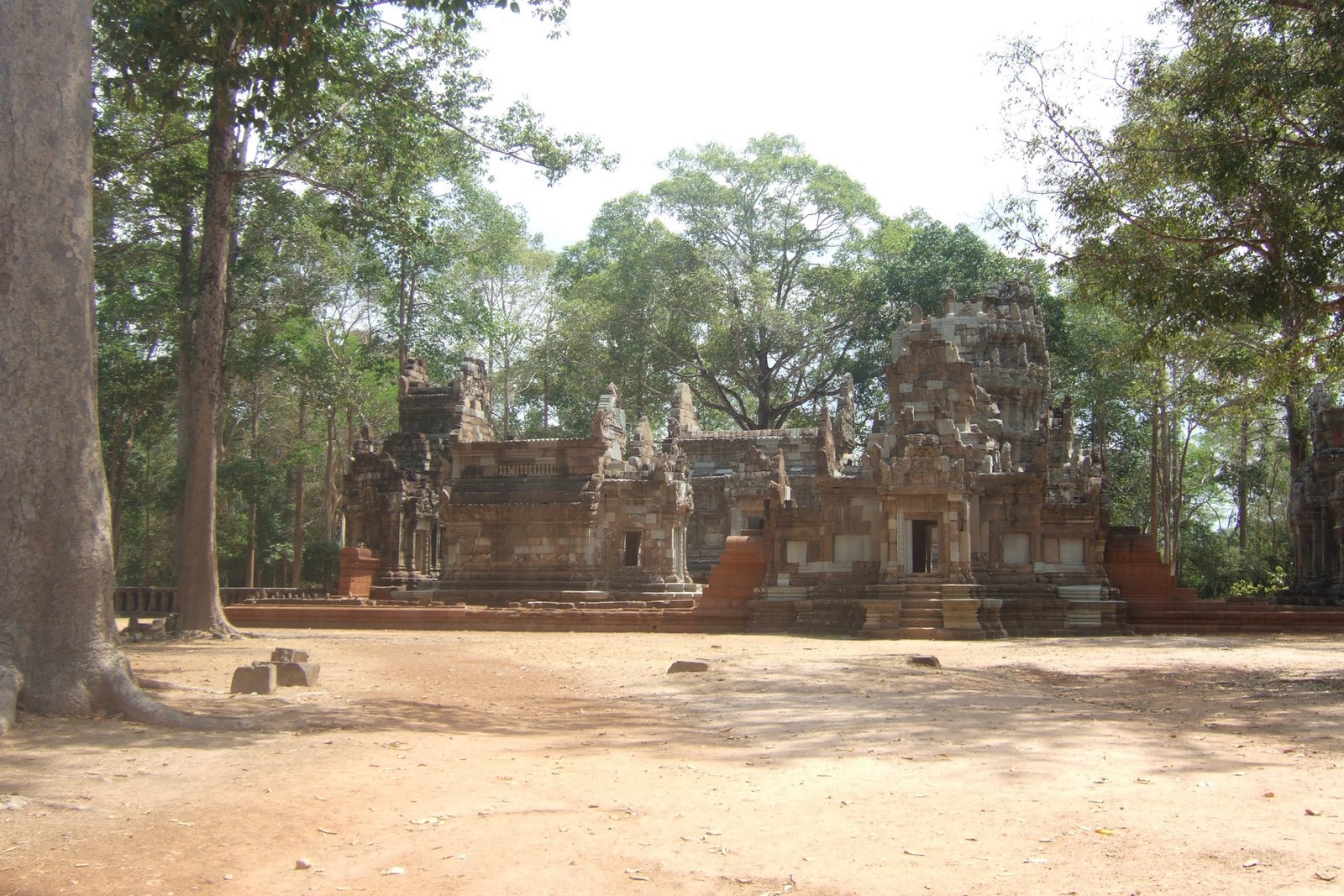
After I left Bayon with my sore feet, I stopped for photo opportunities at the outlying temples and structures, but I'm afraid I haven't got details for most of them. The large picture at the top and the final bas-reliefs below were from an interesting temple constructed from brick, north of Siem Reap and East of Angkor Thom. Interesting because of the quite different construction materials and methods.


A final note on the Khmer Empire. The size, complexity, spirituality, artistic merit, engineering and architectural brilliance of this lost civilisation was awesome to me. Repeatedly in my travels I have been staggered by the achievements of past civilisations, and also, sadly, reflected on the temporary nature of those civilisations. Angkor was literally lost to the jungle for centuries.


I also wonder on the implications that history holds for us. Who knows, some tourist in 3100 may be musing on the same things as he or she (or it) wonders what sort of temple the Sydney Opera House was and who was worshipped there. Or at the New York Stock Exchange, submerged under 100 meters of water.


Cheers, Alan

Thursday, May 22, 2008

Bangkok Grand Palace


Travel Date 11th March 2008.
Click on any picture to see a large version.


And, of course, I had to visit the Grand Palace.


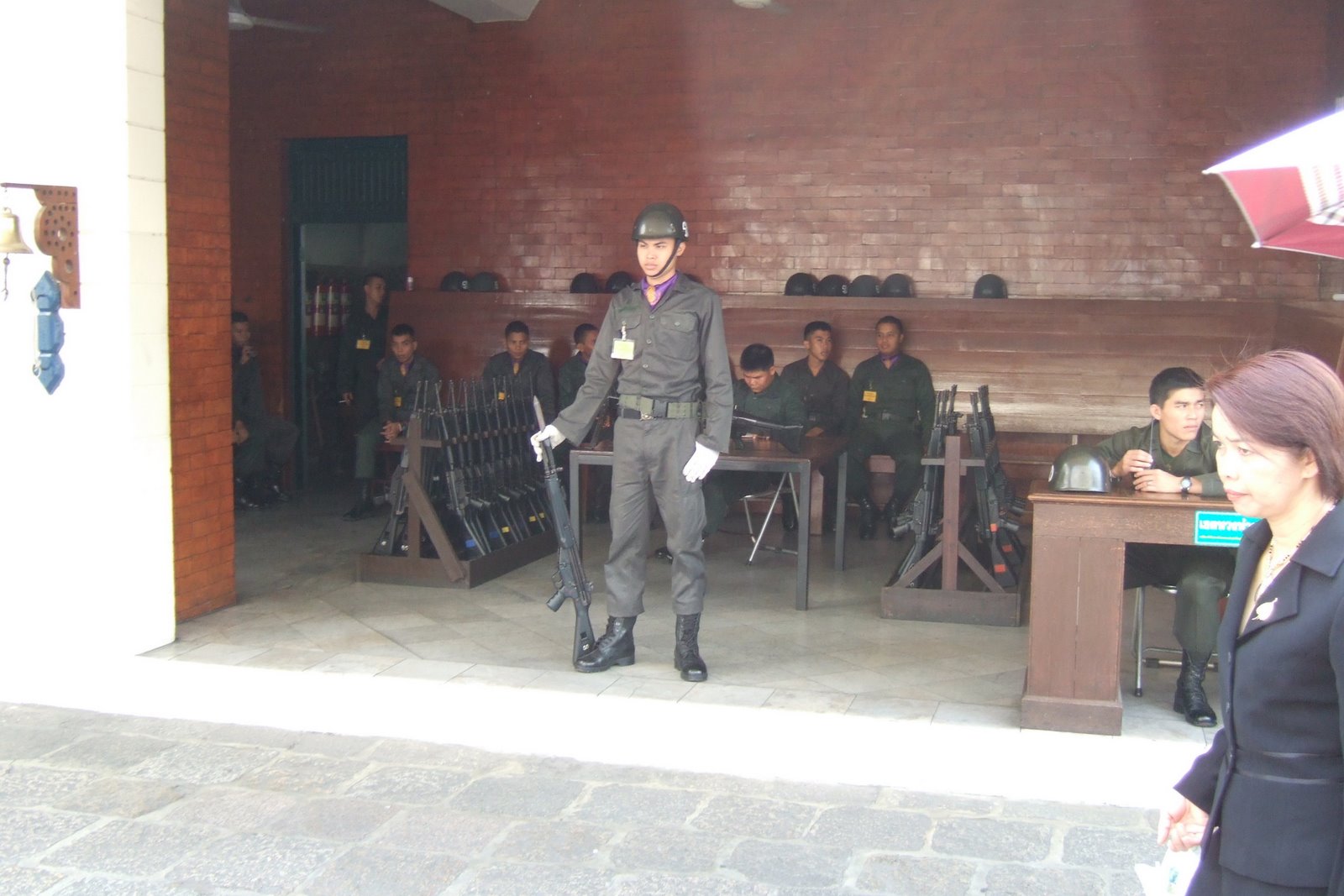
This guy was keeping it safe. So were a lot of others, there were soldiers everywhere.


King Rama I established the Grand Palace in 1782 on his ascension to the throne. He initially built a throne hall and then it just grew, like topsy, over the years. It was used as the Royal Residence with associated government offices until well into the 20th Century.

The most important building is the Royal Monastery of the Emerald Buddha, which is still the most venerated site in Thailand. I was allowed in, after removing footwear, but no photos are allowed inside.

The Emerald Buddha is not actually Emerald But Jade. Still pretty impressive. It was carved some time prior to 1434, when it was first discovered in Chiang Rai, and has wandered then via Lampang and Laos until a conquering army brought it home in 1778.

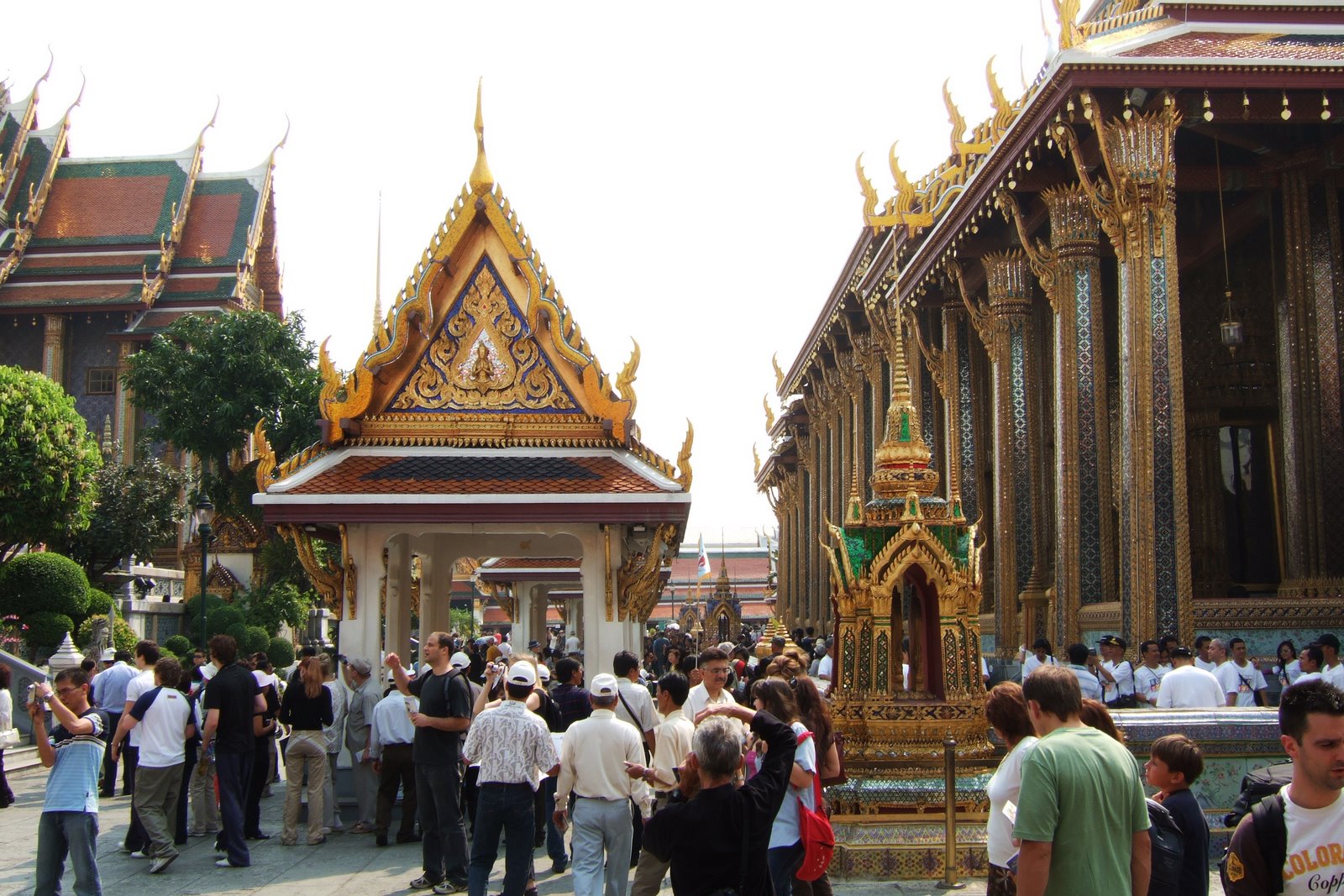
The Grand Palace is a visual feast, almost overwhelming in the riot of colours, shapes, statues, temples, halls and weirdly grotesque amalgams of deities, animals and people.

To be honest, while I loved the place and enjoyed the incredible displays, in artistic terms it was way over the top to me. Extreme colour and extreme forms for their own sake. The workmanship was exquisite, the artistry in some individual aspects sublime - but it was just overwhelming.

But what do I know - remember that I am a philistine; in art terms I am probably tone-deaf - enjoy the photos.


Cheers, Alan

Wednesday, May 14, 2008

Bangkok

Travel Dates 7th, 10th and 11th March 2008.
Click on any picture to see a large version.

There were several ports of call on this trip that were incidental, needed to comply with the One-World Explorer ticket limitations. Bangkok, Hong Kong, London, Washington and New York were all places I went through in order to get to my real goals of seeing some of the Wonders of the World, such as Angkor Wat, the Taj Mahal, Chichen Itza and so on. Where I had choices of intermediate destinations I tried to go to places I had never been before, such as the first two, or those where I could renew old friendships and meet new people, such as the final three.

Thus I went through Bangkok to get to and from Cambodia.

The flight to Bangkok from Sydney seemed to be designed to exacerbate jetlag, even though the time-zone change was trivial. I left the Gold Coast without problems at 11:15 am and arrived in Sydney in plenty of time to transfer across to the International Terminal via the free Qantas bus. I snapped this shot of the world's largest passenger airliner in service, the Singapore Airlines A380, as we crossed between terminals.


Then I found that I had lots more time as the flight was delayed for an unspecified time. We were originally scheduled to arrive in Bangkok at midnight; we eventually got there about 3 am. In the meantime I discovered the only padded seats you could stretch out on in the terminal, bought a novel at the newsagent and finished it before we left. It must have had a gripping plot because I’ve totally forgotten what it was.
I had been able to send an email to the 13 Coins Grand Airport Hotel from a kiosk in the terminal and I was very pleased to see that the hotel representatives were there to greet me despite the lateness of the arrival.

I made a mistake with that booking. The hotel is excellent, the price was low, the rooms are spacious, western style and air-conditioned, excellent (but not air-conditioned) restaurant and free shuttle to the airport. Despite the name the airport was a 15 minute drive; but the main problem was that the drive to the city in a cab was at least an hour in the constantly-clogged Bangkok traffic and smog. Next time I will book a hotel in the centre of town. But if you want a hotel closer to the airport, it’s not a bad choice.


Bangkok was as I expected; dirty, smelly, crowded, noisy and absolutely fascinating. Although I didn't realise until I got to India that Bangkok wasn't really dirty, smelly, crowded or noisy at all by Asian standards.


The food was, as I also expected, marvellous. And cheap. I think I ate more fish in my week in Thailand and Cambodia than I did in the other six weeks of the trip. I also decided to learn Thai cooking when I get home.

I spent most of my time around the Khao San Road, but I did make some side trips to other locales and took a couple of ferry rides on the river.


Many of the old canals have been turned into roads and freeways, but the river is still a major means of transport for the city and the upriver towns. This group of enormous barges were being towed upstream by this improbably small tugboat.
As an ex-cabby, I'm always interested in the cab system wherever I travel. Cabs in Bangkok are very cheap - but quality and security are a bit of a worry. For example, this is the photo of my driver on the cab dashboard - followed by my photo of the driver of that cab.
I only travelled in one cab in my entire time there where the driver bore even a passing resemblance to his photo.

The place is booming with major construction going on everywhere. This is the new Railroad being built to the brand-new airport.


As I noticed in Cambodia, and later in Hong Kong, India and Egypt, "Occupational Health and Safety" does not appear to be a major subject in Asian and Middle Eastern Universities.

This is a view of part of the airport interior, and this is the view of surrounding districts as we took off. Drought does not appear to be a problem here; to Aussie eyes the water everywhere looks almost extravagant.


I should mention the Thai monarchy.


Everywhere I went I saw pictures of the King or the Royal Family; some celebrating his long reign, some his birthday, some just "Long Live the King". Part of the Grand Palace was closed for memorial services for a beloved Princess who died two months before I arrived and one of the local TV channels seemed to be dedicated to the service and stories of her good works for the entire time I was there.


Initially I thought it may be an enormous PR effort by the Palace, but I noticed that many private homes, no matter how humble, had pictures of the king or Queen.
Maybe the feeling of stability a Monarchy provides has become more important in a country where the government below that level doesn't always change peacefully at the ballot box. The group photo is in the gate lounge at the airport and I took the final shot as I sat in the Cathay Pacific 777 after boarding.

Cheers, Alan