About Me

My photo
I'm an Aussie who likes wandering all over the world but keeps coming back home to paradise and my family. If you are reading this on one of my travel blogs, I hope you enjoy reading them as much as I enjoyed creating them. If you are reading the Diabetes and weight loss blog - I hope it helps in your battle with the beast. Cheers, Alan
Showing posts with label Burma. Show all posts

Thursday, May 09, 2013

Inle Lake, Myanmar, Markets, Crafts and Villages


 Travel Date 26th November 2012.
Click on any picture to see a larger version.
   

After a prolonged absence from the blog it is time to start recording my travels again. The urge to write waxes and wanes. I am pleased to see so many readers dropping in to vicariously enjoy some of the places I have visited, but I have to be honest. I write these reports selfishly for my own future enjoyment. In less than fifteen years I will be 80. Who knows if I will be able to remember my travels then, let alone still be able to wander distant lands?

I have too many countries unwritten from past journeys: China, England, Ireland, Scotland, Belgium, Luxembourg (well, we were only there two hours so I won't write that one) the Netherlands, Germany, the USA, Canada, Mexico, Hungary, Slovakia, Poland and Russia. I will make an effort to catch up over the next few months.

I hope my future self enjoys reading these travel logs as much as I enjoyed the journeys which led to them. I have noticed that is where I differ from many travellers. Whether I am on a 12-hour flight out of Australia, anticipating landing in exotic lands; or relaxing in a train quietly enjoying the passing scenery; or driving on the wrong side of the road in Europe or the USA, turning into an unmarked narrow lane to see where it goes; or slowly cruising down a mighty river or on a lake I enjoy the journey just as much as the destination.


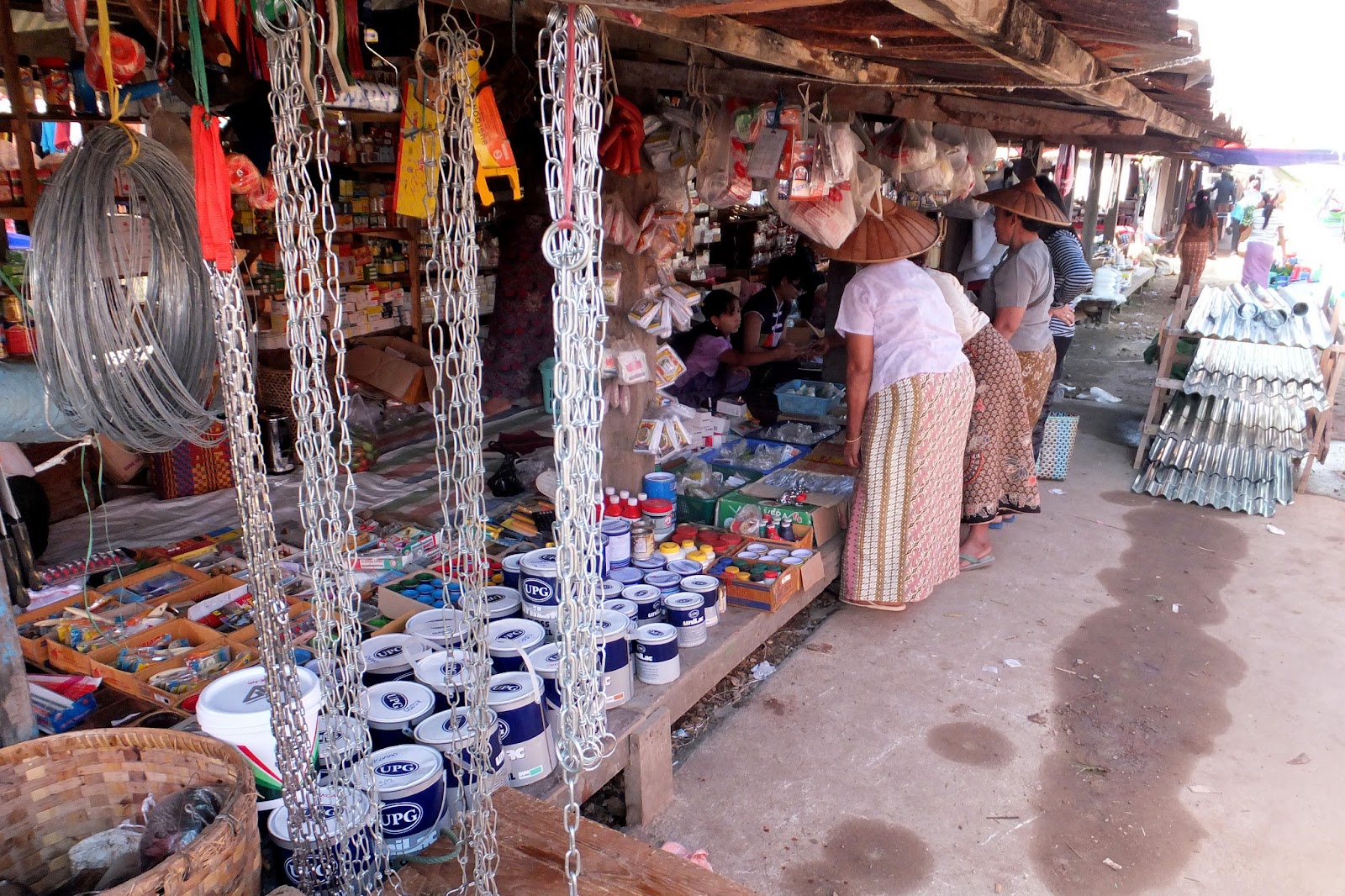
After cruising the full length of the lake south from Nyaung Shwe we came to the market at Nam Pan for a leisurely hour. This is a shore-based market, unlike the floating market which was elsewhere that day. Although there were quite a few tourists there were no pushy vendors selling souvenirs or other trinkets. There were stalls selling those items, but the proprietors waited for the customers to come to them. A very refreshing change from many Asian markets. The market was primarily meeting a different need, acting as the local shops, supermarket, restaurant, tavern and meeting place for the locals who were kind enough to politely ignore the strangers wandering through their shopping centre. Reports from tourists later suggested that the floating market is more tourist-oriented.


Bullock or ox carts appeared to be the vehicles of choice for the farmers supplying the markets. There were horse-carts used as taxis in the small towns but I saw very few horses in the countryside. 


The fish were all fresh caught. With no refrigeration on a warm morning most were still alive, being regularly sprinkled with water to keep them fresh as long as possible. 

For tourists, there is a convenience problem, or more accurately a lack of conveniences. Eventually I wandered back to a stand of trees near the boat and found a queue of westerners waiting near the trees politely ignoring each other and pretending to be deaf as we waited our turn. Those trees should eventually grow as tall as mighty redwoods...

After leaving Nam Pan we cruised slowly through several villages on stilts. There are many dotted round the southern shores of the lake. I'm not sure why most are down there rather than further north. Possibly this section still survives when the northern parts of the shallow lake dry up.
 

Eventually we came to Inpawkhon village to see the fascinating but very labour-intensive process of lotus-weaving. A short section of root is half-cut and snapped. The sticky threads in the core are stretched and rolled, then the process is repeated for hours until sufficient yarn is produced for weaving.


They also produce silk from silkworm cocoons in the same small craft factory.


There were far more structures on the lake and creeks than on shore, with powered long-boats and shorter light punts being the primary means of transport. I can't recall seeing any motor vehicles during my visit to the lake.

School was on dry land, but only just.


This golden swan-duck is stored to become the superstructure of a barge progressing the Hanthi around the lake at festival time.

The three of us, temporary companions, had a pleasant lunch at a tourist restaurant opposite the Hpaung Daw U Pagoda. The small buddhas inside the pagoda had so many layers of gold leaf on them from worshippers that they had become unrecognisable blobs.


After seeing the pagoda after lunch we cruised up the creek to Indein. Our boatman apparently did not want to pay jetty fees, so we clambered up the bank a few hundred metres short of the village and wandered through a path to town.


By this time I was hot, thirsty, weary and 'pagodaed out'. While the others trekked off to see more pagodas I waited in the local café. Before my cold beer I tried the local coconut. First, I bought my coconut and gave it to the man with the machete, who accurately chopped it to allow a straw to be placed in the coconut milk without spillage. After drinking all the milk, which was surprisingly refreshing, I took it back to the machete man who sliced it in two and gave me a sharp spoon to scoop out the meat. There was quite a lot of milk but not much meat. 
 

This young man near the café was catching tiny fish, shorter than his little finger, with a short length of line on the end of his bamboo rod. I doubt they were for dinner, possibly bait for later use.


  Why use a boat when the cargo floats? Bamboo heading to its destination.


These floating gardens were at the southwestern corner of the Lake and covered a very large area. The floating vegetable beds are anchored in position by the stakes driven through them into the lake-bottom. 
 

The following day was spent wandering around the town, re-visiting the market and walking the small back streets. When I departed Nyaung Shwe I shared a limousine to Heho airport with a couple of back-packers, arranged through the same agency as the boat trip. The flight back to Yangon, and later back to Australia via Bangkok, was uneventful - for me. Exactly one month later this happened to the aircraft I flew out on as it approached Heho: 

Christmas miracle for Burma crash survivors

 I'm just lucky, I guess.

Cheers, Alan

Thursday, February 07, 2013

Inle Lake, Myanmar, On the Water


 Travel Date 26th November 2012.
Click on any picture to see a larger version. 


Most of the sites visited by tourists are on the southern shores of Inle Lake. There are several villages and hotels in the south but they tend to be more up-market, often set on stilts over the water and needing a boat to access the local facilities. The main tourist accommodation town is Nyaung Shwe, on an inlet to the north-east of the lake. 

As the lake is about 20km long and up to 10km wide, depending on whether it is the wet or dry season, it takes about an hour each way in a long boat from Nyaung Shwe to the markets, pagodas and villages at the southern end. I liked Nyaung Shwe and enjoyed the boat trips both ways. In hindsight I am pleased I stayed in town instead of down south.

The next post will be about the markets, villages, pagodas and monasteries on the southern lake. This post is only about getting there and back, to keep the number of pictures reasonable.

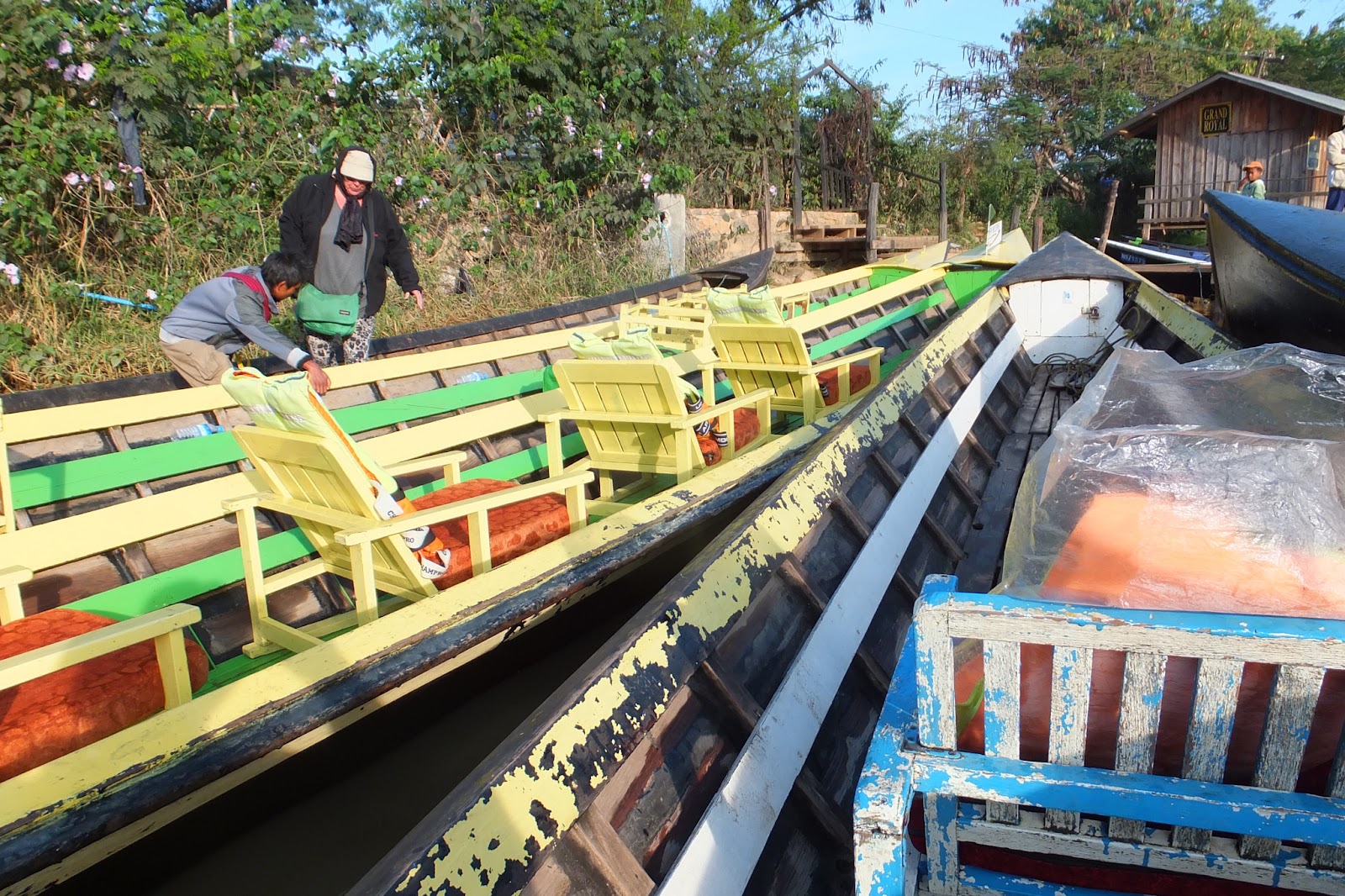
The lake is the primary transport route for those living on and around it. There were two main forms of boat. These are examples of the long, slim, powered boats used to transport tourists, locals and goods long distances on the lake.


To arrange the boat trip I wandered into half a dozen of the small tourist offices that line the main street of Nyaung Shwe. There are variations on the price depending on the tour stops, how many craft workshops are included (more is cheaper, because each gives a commission to the operator) and how many passengers. This lady from Austria was looking for another passenger to defray the cost; eventually a man from Belgium joined us. They both spoke English. It was pleasant to have others to chat to during the day.


As we headed south early in the morning the weather looked a bit ominous, with low clouds and some rain in the surrounding hills.


By the time we reached the southern shore the weather had cleared to a fine, warm day. Later I was grateful I had been liberal with the sunblock that morning as one of my companions turned a nice shade of lobster.

The fishermen and others who harvest the lake's resources use shorter, narrower boats propelled by poles or oars using their legs for extra power. They are also used for local transport near the villages.


Most of the lake is only a couple of meters deep for most of the year. As well as villages on stilts there are other buildings on stilts in the most unlikely places. This appeared to be some sort of administrative building; deserted on the day but in good order. 


There were several shrines like this in the middle of the lake. Later, as we headed for home in the twilight, I noticed that neither the boats nor these shrines appeared to have lighting. Presumably the boatmen know their lake and their routes very well. 


Not all the men on the lake were fishing; there were several groups of lake-weed gatherers. It is laborious work, using a long pole to push under the weeds growing on the bottom, lifting the wet mass into the boat, then quickly baling to prevent the draining water from capsizing the boat.

Later we saw the dried weed being sold in the market.


After a long day we headed for home at dusk as a beautiful sunset slowly appeared to the west.


The walk from the jetty back to the Amazing Hotel seemed to have become longer as I walked home. A Myanmar beer went down very well on arrival.

Cheers, Alan 

Tuesday, January 15, 2013

Fire Balloons Festival 2012, Taung Gyi, Myanmar


Travel Date 25th November 2012.
Click on any picture to see a larger version.   


Note: there are five videos and several pictures in this post. Be patient, it may load slowly.

When preparing for the trip I was aware that there was a balloon festival celebrating the full moon near Inle Lake but I thought I would be too early for the event. By chance, when I was dropping my laundry off at the travel agency near the hotel a Swedish traveller was looking for extra passengers to defray the cost of a car to Taung Gyi for the balloon festival that night. The event occurs over several nights, not just one as I had thought. When I returned a couple of hours later I found we were joined by a young back-packing couple from Belgium and France.

Taung Gyi is the capital of Shan State with a population of about 200,000 but that swells at festival time. It is only 40km(25miles) from Nyaung Shwe, but it seemed a long journey in the ancient small Corolla with seats and suspension which had seen many better days. About half-way there the terrain changed quite suddenly from flat and swampy to steep and mountainous. The traffic also got heavier as it seemed that everyone was heading to the festival. Taung Gyi sits in a shallow mountain valley and spreads across the nearby crests.

We arrived at dusk. Apparently there had been several balloons in the afternoon. We arrived in the lull between shows. We were told the more spectacular night balloons would start about 7:30 pm. The crowds grew swiftly. By the time the balloons went up this area was packed solid. 

 
The area surrounding the balloon field was full of sideshows; mainly restaurants, bars, gambling stalls and rides. 


I was surprised to see so many games of chance and gambling. Every second stall seemed to be gambling in one form or another. 


The crowd kept growing. Numbers are hard to estimate, but by the time the first balloon rose there appeared to be at least a couple of hundred thousand, probably more, when compared with crowds I have been part of at major events in Sydney and Melbourne.

I had a full meal here for 1000 kyats, sitting on a stool and at a table that would have looked small in a kindergarten. 


After I finished eating and paid the lady kept bringing me extra helpings. She seemed very crestfallen when I eventually refused more. She would not accept extra payment. I think it was because several other Westerners had bought meals when they saw me eating at her establishment. Apparently I was a draw-card. Or a guinea pig.

There were lots of other food stalls; later I bought a bag of these tiny savoury profiterole-style mouthfuls. Delicious.

 
When I first saw the brightly lit Ferris Wheels I was surprised to see that the operators did not mind some local youths climbing up them. When the wheel started to rotate they would swing from the structure and jump off athletically as they passed the ground, sometimes going around again while hanging from the bars if they got the timing wrong. It took me a while to realise that the Ferris Wheels have no motors and that the youths were paid by the operator to rotate it. The people on the ride were very patient, sometimes waiting for long periods until all the seats were full before the operator sent the boys up top to send it spinning. 


The balloons are made from the local Shan paper. They are enormous, prepared off-site by enthusiasts and brought to the location in small trucks. When taken off the truck the balloon is a folded paper bundle about 3m(10') square and 15-30cm(6"-12") thick. It is held overhead and carefully unfolded and spread until the ring at the base is clear. 


 While that is happening three fire-sticks are prepared away from the balloon, ready to place a roaring fire under the cleared ring.


The hot air rising from this blaze provides the initial inflation to expand the balloon.


I saw a balloon raised every half hour or so until midnight. It was quite amazing that not one caught fire during the preparation stage. Once the balloon is inflated the fire on the ground is replaced by a pole up the centre with fuel and burners attached.


As the balloon reaches the point where it has lift and needs to be restrained to remain on the ground, a load is attached. In some cases the load was advertising or displays made from many lit candles, but in others it was a spiral of fireworks weighing up to 50 kg (110lbs). The fireworks were attached carefully below the dripping, blazing inner core fire. Once the balloon had sufficient lift the fireworks fuse was lit and the balloon sailed into the sky. The spiral of fireworks burned in a way that released the spiral to become a long tail. Then the fireworks provided a brilliant display, sometimes for quite a while. 


In this case the balloon was released before it had enough lift. It went sideways instead of up. The results were spectacular. 


Notice the people at the base running into the flames. Sorry about the shaky cameraman; I was holding a beer in one hand, the camera in the other and being bumped by lots of very excited people.  Later I was told that no-one was killed, which seemed incredible. A few days later it was rumoured that two people were injured. One was the man who released the balloon early. It was not clear whether he was injured by the crowd he endangered or the police who attempted to arrest him. The other was one of those police when the friends of the balloon man defended him.


The backpacker couple wanted to stay watching balloons until they ceased at 2am, but the Swedish guy and I both had boat bookings on Inle Lake for the early morning so we convinced them to leave at midnight.  


We had a further delay while we helped our unfortunate driver search for his mobile phone, which he had lost during the evening. Sadly for him, we did not find it. I arrived back at the hotel about 1am.


It was a fascinating and enjoyable night. One of those experiences I'll never forget.

Cheers, Alan