About Me

My photo
I'm an Aussie who likes wandering all over the world but keeps coming back home to paradise and my family. If you are reading this on one of my travel blogs, I hope you enjoy reading them as much as I enjoyed creating them. If you are reading the Diabetes and weight loss blog - I hope it helps in your battle with the beast. Cheers, Alan
Showing posts with label Beijing. Show all posts

Tuesday, February 25, 2014

The Forbidden City and Summer Palace


Travel Dates 12th-14th April 2012.
Click on any picture to see a large version.   


The name of the Forbidden City reflects the period when only the Emperor (or occasionally a Dowager Empress) and the Emperor's concubines, ministers and eunuchs were allowed within the walls on pain of death. Construction was started in 1406 by Zhu De, the son of the previous Emperor who had moved the capital south to Nanjing. Zhu Di usurped his father in 1402 and, after completing construction of the Forbidden City in 1420 slowly moved the capital back to Beijing. 

As a personal aside, I've never understood that move. Beijing was much closer to the Mongol and Manchu threats from the north and north-west, with both consequently ruling China in different eras, and the climate, compared to Nanjing, is very harsh. But no-one argues with the Emperor, thus Beijing became the capital and remains so to this day.

China was ruled from the thrones within these walls from 1420 until 1911, apart from occasional breaks during wars, invasions by foreign devils in 1860 and 1900, and some periods of anarchy.


The last Emperor remained, under sufferance, until  evicted in 1924 and the process of turning the complex into a museum began in 1925. Over the centuries it was damaged many times and some sections were burnt to the ground, but it has been reconstructed faithfully to the original design. The walls enclose 72 hectares (~180 acres) with 980 buildings including about 9000 rooms. The outer, smaller buildings were for the staff. The Emperor very rarely left the inner Palace rooms.


Diagram source
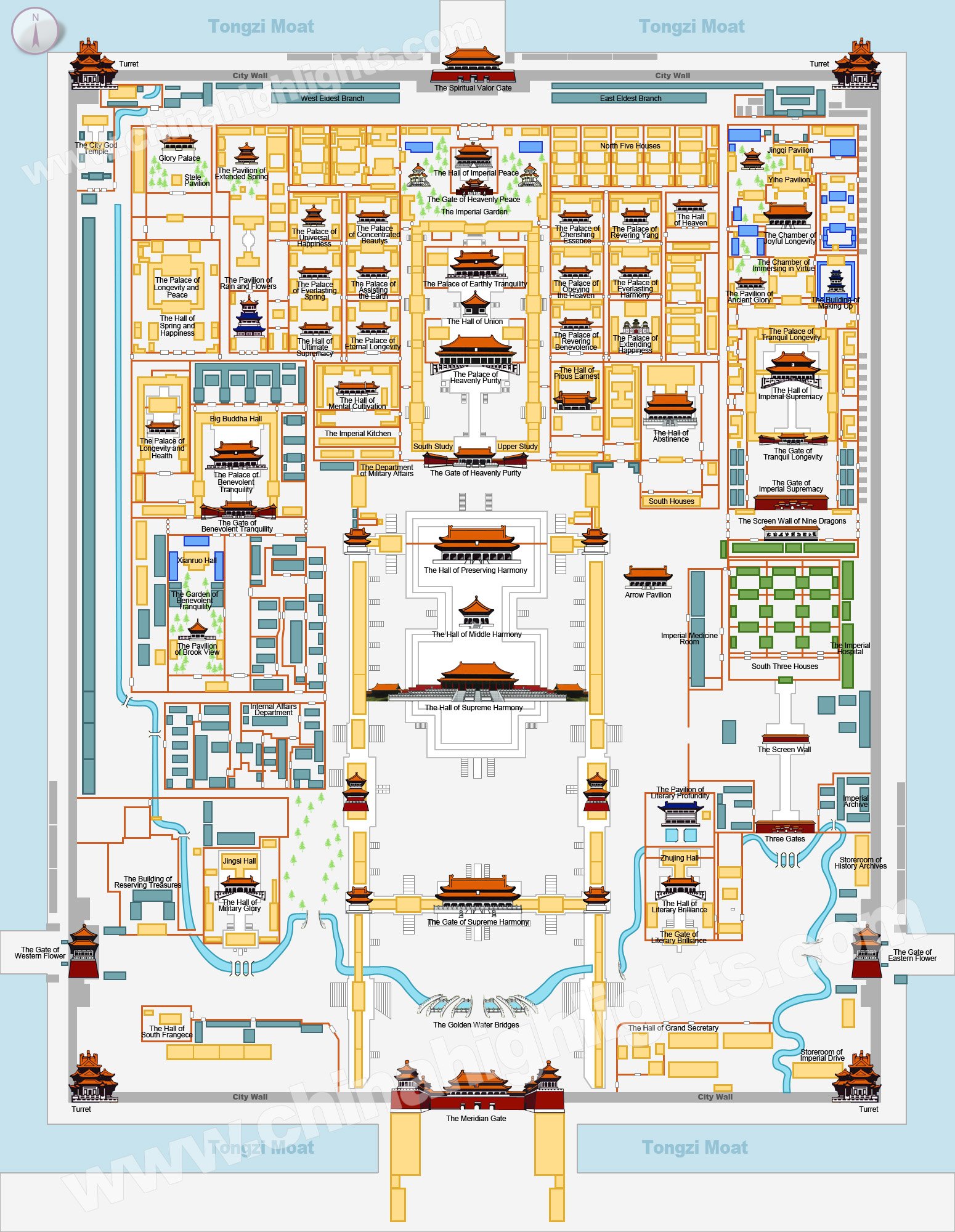
We strolled through the complex for a few hours, discovering a small section with a cafe for lunch. Where possible we avoided the large organised tour groups, mainly Chinese, and took our time.


At the risk of lowering the tone of this post, two incidents reminded us that toilet matters are viewed differently in China. One of the first things we noticed on arriving in China was the lack of toddlers in nappies. There were some, but most wore trousers with a split at the rear. When nature called their mothers supervised as they simply squatted where they were. In the more refined areas they were led to the side of the footpath or the gutter. We learned to watch where we stepped. In the Forbidden city this seemed to be frowned on and we noticed several parents with supplies of tissues and a plastic bag, using them to perform the same functions as we would when walking the dog. The Forbidden City was the only place I noted that extra care. We were surprised, while sitting for a rest between Palaces, when a couple appeared embarrassed and apologised to us when their youngster just missed our shoes.

It was also the only place I saw a four star rest room. Actually, it was the only place in China I saw a rest room with any stars at all.


After a long but pleasant day we grabbed a cheap cab at the north entrance for the short trip back to the hotel.


On our second last day in Beijing we went to the Summer Palace.


This was one of the more relaxed days of the trip. Which is exactly what the ancient Emperors wanted their Summer Palace to be. A place to spend their summers lazing beside a lake.

We decided to blow the budget and take a cab. The Summer Palace is about 25km (15 miles) from Wangfujing Street. The fare was reasonable, but our driver dropped us about 800m away around a corner from the entrance when a fare waved her down. She refused to take us any further when she found her new passenger wanted to go back to the city. So we went for a walk after asking directions of a passing stranger.


We were lucky to arrive on a day when it was not overcrowded. For the next hour we wandered leisurely around the grounds and gardens.
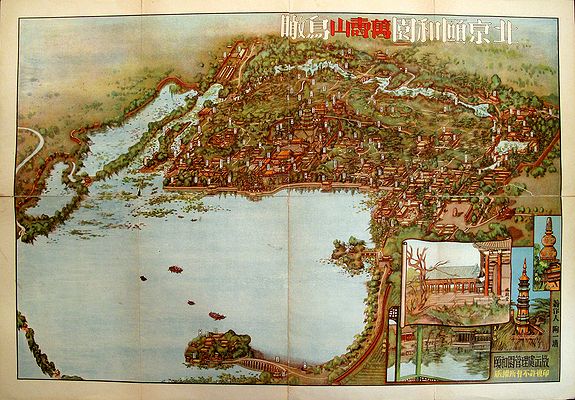

Source.


I hired one of the electric boats for an hour; if I recall correctly it cost 300RMB.. Kunming Lake is far too big to explore in an hour. We stayed in the northern section.


We cruised slowly down towards the Seventeen-Arch Bridge then wandered past Nanhu Island, up the western shore and back via the marble ship and the massive hillside palaces. It is a pleasant and relaxing way to spend an hour. I can see why the Emperors and the Dowager Empress liked the place.


The original imitation boat in the lake was built in 1755 as a wooden and marble representation of a sailing ship on a base of huge stones. A prominent Tang Dynasty prime minister, Wei Zheng, once said, "Water can carry the boat as well as overturn it." to remind the Emperor that water symbolising the common people can support a good emperor or overthrow a bad emperor.

In 1860 a fire resulted in all of the wooden structure being destroyed and only the marble hull and support stones remaining. In 1893 the Empress Dowager Cixi was rather far removed from the reality of the world outside the Forbidden City and the Summer Palace. She decided to use the funds meant to rebuild the Navy to build this lavishly ornate marble boat and expand the Summer Palace. When the Navy complained she presented them with the boat.

Not surprisingly the water-borne under-funded Navy was totally destroyed in a sea battle seven years later.


It was an enjoyable and pleasant visit.

Cheers, Alan

Monday, June 03, 2013

The Great Wall of China


Travel Date 13th April 2012.
Click on any picture to see a large version.   


I used one of the inexpensive group day tours to the Great Wall.

If you are on a tight budget I recommend this method. It was excellent value. My memory is fading and I am not totally certain that this was the company I used, if not it is very similar: Great Wall at Mutianyu and Sacred Way (Ming Tomb) one day tour 200 RMB p/p

Lorraine decided there would be too much walking and climbing at the Wall so I went alone. For 200RMB (~$33) I received transportation in a minibus to and from my hotel to the wall, a tour through the Ming Tombs en-route and lunch included. We had a guide for the en-route visits. He led us to the cable car at the Great Wall but left us to our own devices for the two or three hours we spent on the wall itself. The tickets for the cable car and wall entry were extra, but not expensive. There were also obligatory stops of about an hour at jade and silk factories. We declined the optional tea shop. I did not mind those. I found them interesting, they broke up the long trip each way and there was no hard sell to buy the products.

After pick up from the hotel at 7:15 am the first stop was the Ming Tombs. 


It was a pleasant break on the journey. Lots of stairs to climb and descend, but not really of great interest to me so I'll slip past them. Possibly I've seen too many mausoleums in too many places.


The jade factory was next. See my previous post for pictures of the exquisite work on display there.

Lunch was surprisingly good. Beer was extra. There were nine of us around the table. Nobody left hungry.


During the trip our guide, who spoke excellent and clear English, presented a brief history of the Ming Tombs and then of the Wall. During general discussions he also gave a fascinating insight into life for a man in modern China in his early 20s saving for marriage and a family. He lived in a single room apartment in a multi-storey building with shared bathing and dining facilities. He was from a town in the far north-east, 22 hours from Beijing by rail. He could only afford to make the journey to see his parents and grandparents once or twice a year.   

He gave a different perspective to the one-child policy. He and his fiancée were both the only children of their parents, in accordance with the policy. A major problem they face is that traditionally, when families were larger, the children looked after parents and grand-parents. When there were lots of kids those responsibilities were shared among many. As the economy and political system changes from the old Communism the State support system for the aged is no longer as good as it was in the Mao years. He and his fiancée are facing a future where they may be the only financial support for not only their own future child but also four aged parents and eight aged grand-parents, all alive at this time.


This Bactrian Camel was beside the tourist buses at Mutianyu, apparently waiting for someone.


I chose Mutianyu for several reasons. The most important was that it is less crowded with tourists. It is also an excellent example of the incredible engineering skills of the wall's architects, the rugged terrain and the harsh conditions the workers faced building it.


The Mutianyu Great Wall is about 80km (50 miles) north of Beijing; a little further from town than the more popular Badaling section. This section of Great Wall was the northern barrier defending the capital and the imperial tombs. It is not as old as some sections, being originally built in the mid-6th century A.D. although it is older than Badaling. 

It is very well preserved, partly because much of it was rebuilt in the late 16th century during the Ming Dynasty. It is generally considered to be the largest construction scale and best quality among all sections of Great Wall. In the mid-1980s there was further reconstruction. An interesting difference to most of the other sections of the Great Wall is inclusion of crenelations with merlons on both the inner and outer parapets, allowing archers to repel attacks from both sides.


There are towers at regular interval along the wall. These were not only fortifications but also troop living quarters.


Different sections of the wall were built in different eras, often by soldiers but sometimes by forced labour and even children. Many workers died during the construction. The life of a soldier posted to the wall must have been horrific during the harsh northern winters, even worse if they were attacked.


My hiking days are over. The cable car was a welcome improvement for access.


The long trip home was broken by the visit to the silk factory.

Our only minor problem of the day occurred when the driver, who spoke no English, refused to switch on the air-conditioner to save fuel. It was hot and uncomfortable down the back of the bus and the passengers held a mutiny. The air-con went on. I arrived back at the hotel at 6pm after a long but very interesting day.

Cheers, Alan