About Me

My photo
I'm an Aussie who likes wandering all over the world but keeps coming back home to paradise and my family. If you are reading this on one of my travel blogs, I hope you enjoy reading them as much as I enjoyed creating them. If you are reading the Diabetes and weight loss blog - I hope it helps in your battle with the beast. Cheers, Alan
Showing posts with label Oceania. Show all posts

Wednesday, January 19, 2011

BA to Sydney via the Edge of Antarctica


Please click on any picture to see the larger version.
Travel Date 5th-6th May 2010.

I don't post a lot of pictures taken through the aircraft portholes, but these are a little different to the usual.

The flight from Buenos Aires to Sydney appears short on paper. Take-off is at 2 pm, arrival at 5:50 pm. But that is deceptive because it is actually fifteen hours long, crossing many time zones and the date-line. The flight stewards treat it like a night flight, with most people closing the window covers and settling down for a snooze shortly after take-off. But not me.

If you look at a standard Mercator's projection map of the world you might think a flight from BA to Sydney heads straight across the Pacific Ocean, crossing Chile and heading for Sydney via Tahiti and the top of New Zealand. But that is also deceptive. In fact, the shortest route heads straight down the east coast of Argentina, passing over Patagonia and Tierra Del Fuego and skirting the edge of Antarctica.

I was glued to the window, fascinated by the terrain we passed over. This is some of the most inhospitable land in the world. And also some of the most inhospitable seas. The channels between the islands of Tierra Del Fuego hide the remains of many ships and their crews from the sail era.


Then the skies slowly changed colour; it was like flying through a pastel rainbow.


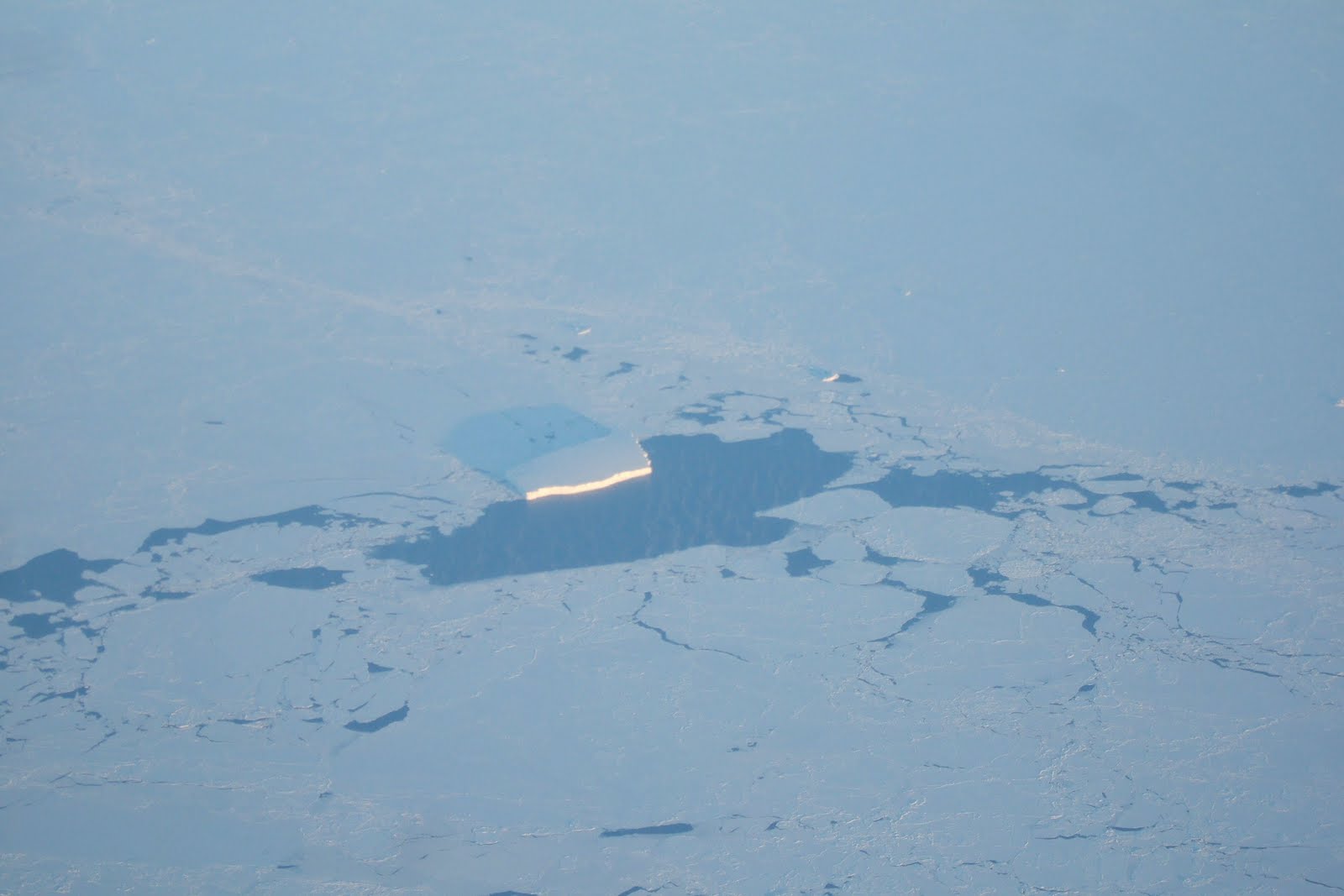
Slowly, the sea turned from the blue of the deep ocean to the ice-blue of the great ice-sheets of the Antarctic fringe, dotted with icebergs. The size of these icebergs is so enormous it is difficult to describe. At one stage we passed over a ship that was not far from a berg. It was like a speck; just a dot compared to the iceberg near it. Unfortunately, I missed that photo.


Each berg had a corresponding ice-free lake in its lee. I think it is created by the currents as the berg becomes an ice-breaker, pushing against the surrounding ice sheet and leaving clear sea in its wake.


Most people hate long flights. I must admit I enjoyed this one. It helped that, as usual, the Qantas service and food was excellent.

And so the journey around South America ended. I had a fascinating time; some day I may return. But there is still so much of the world to see...

Cheers, Alan

Friday, September 18, 2009

Noumea Revisited


Our hotel is between the palms.

Travel dates 21st and 22nd August 2009
Click on any picture to see a larger version.


After a pleasant night at the excellent Hotel Banu (review awaiting approval on Tripadvisor) we headed south to spend our final two New Caledonian nights in Noumea.

We took our time, just enjoying a relaxed drive.


The picture exemplifies the Grand Terre west coast north of Noumea outside the towns: few dwellings, open spaces, hills and mountains rising from the pasture but very few animals to be seen in those pastures.

Then we were back in "civilisation". After some of the hotels we stayed in during this trip we thought Le Pacifique was marvellous. Yes, I'm getting soft. The pool was the view from our window. Here are the intrepid wanderers, off to see Noumea.


Once we had settled in we wandered the city with no particular place to go. I pretended I knew where I was going, so I was headed for the docks to get to the market when we came across this hilltop Catholic shrine. At least I could see the docks from here. When we finally reached the docks, we could have been in the Mediterranean; extensive marinas and lots of expensive pleasure boats.


The views that the saint was surveying were superb; the shrine was still in use, the small grotto had several candles in it.


The shops were modern and well-stocked with items from all over the world but mainly New Zealand and France and, of course, China. The Kanak penchant for Rasta items was everywhere, with Bob Marley popular as a symbol. So was Che Guevara; see the white T-shirt. Two very different heroes. I respect Marley's music and Guevara's ideals. But I'm less impressed by Marley's penchant for pot and Guevara's bloody methods. I hope the Kanak youth are able to use some discrimination in following their heroes.


Down-town Noumea could have been any French town. This is a typical down-town street.


Next to the dock was Le Marche, the market, in full swing. Not an enormous market under cover, but a very wide range of fruits and vegetables, meats, fish and bakery goods and of course souvenirs and knick-knacks. Compared to many markets we have been to in our travels it was very civilised and orderly with no-one aggressively pushing their wares or harassing obvious tourists like ourselves. The souvenir prices for cowrie shells, carved totems and similar items were many times higher than those we passed on roadside "honour" stalls in the north.


As we left the market we heard a lot of noise and noticed a demonstration heading towards us on the highway beside the market. It was quite large with several thousand demonstrators but very orderly. There were three trucks with sound systems regularly spaced along the group of marchers with people making speeches from the trucks as they steadily rolled along. The majority of marchers were Kanak but there were a few Caldoche among them. Caldoche is the term used for the new Caledonians of French or European ancestry.


The demonstration went on for several hours, winding throught the streets north of the market in an older section of town, with the trucks stopping for the speakers to address the crowd at regular intervals. Between speeches music entertained the marchers. The procession was followed at a discreet distance by a fleet of police vehicles and several walking police, but they weren't over-bearing in their presence. I had no idea what it was about, so I looked it up since. The background story is here. It looks like they have a pretty good cause to complain to me.

That night we were on our way home from dinner when we saw this guy. New Caledonia was expensive, but haircuts must be really, really expensive.


The following day we had a little trouble getting out of the hotel car-park; as we reached the side street we found it barricaded with witches hats down the centre. It was a bit unclear which side of the road was available for us to drive on. Eventually a friendly guy saw our confusion and showed us the way. We had not realised that one of the biggest sporting events of the year, the local marathon, was taking place that morning. We had seen signs and bill-boards with pictures of athletes, but not realised their import. We tried not to run over any of the competitors.

Then we headed south, intending to head for the South-east tip of the island, but never quite made it. Instead we wandered some of the southern villages before heading home.

At one stage we stopped at an enormous supermarket several kilometres south of Noumea in a building like a giant warehouse. It was like a combination of a K-mart and supermarket in one space. Again, very French in style and layout. For example, the red meats were nearly all displayed in large cuts, such as a full rump (or flank) with a butcher standing by to slice it to your needs. There were very few of the plastic-packaged slices of meat we see in supermarkets at home. On the other hand, the cutting board the butcher was using looked rather unappetising as it was crawling with flies, which he casually brushed away as he tossed a lump of meat down for slicing.

The range of packaged fish was excellent; I would love to be able to buy a marlin/mahi mahi/tuna shashlik like this to throw on the barby at home.


This was the spot where I had my last New Caledonian (and quite pleasant) beer; life is tough. The final views are the trusty little chariot that took us around the island, the sunset from the hotel, and a glimpse of the lagoon as we departed.


Departure was little annoying. There are so many good things about New Caledonia, but the understanding of many people within the local tourist industry of the needs of tourists is not one of them. I've tried not to concentrate on the negatives in these blog reports, although you will find some negatives in the hotel reviews, but some of the annoyances will have surfaced. At the airport they included the duty-free shop where I wanted to get rid of the last of my Pacific Francs. The clerk was happy to accept part cash, part card, but the remainder after cash was less than XPF1000 which is a little over AU$14. She refused to accept less than 1000 for the card. Nowhere else had we come across this minimum, but I had to buy extra to meet the requirement. Trivial, but annoying.

Earlier, Air Calin opened check-in late; no big deal but there was already a long queue waiting at the right time. However, they were good compared to the girl handling the departure passport check. She left a long queue waiting outside her closed door for another hour until less than an hour before departure time. We presumed she enjoyed a leisurely afternoon siesta. No-one let the waiting queue, for the only departing plane, know what was happening or when the door would open. Again trivial but annoying. Little annoyances add up over a week and they were just a few examples of many which displayed the local attitude to tourists.

It's a lovely island, like two nations - Noumea and the rest - in one locality and the people we met who weren't in the tourism industry, and some who were, were also lovely. But I probably won't be back even though it's only two hours away. Despite that, I'm glad I went.

Cheers, Alan

Monday, September 14, 2009

Poindimié and Nickel Mines to La Foa


Travel dates 19th and 2oth August 2009
Click on any picture to see a larger version.

We left around 9 am after a leisurely breakfast, cooked on my trusty little skillet. The dawn view was glorious, interrupted by a couple of inquisitive deer. We decided to make it a short day's drive, intending to have a relaxing afternoon at the next town. The scenery was similar to the day before with the road separating the steep hills from the beautiful beaches with occasional small coastal plains. The small Melanesian "Tribu" villages were more frequent and so were the pedestrians, with always a smile and a small wave acknowledging us as we passed.

A pleasant observation was the care taken in caring for the departed in New Caledonia. The grounds were always well looked after and it seemed that every grave had fresh floral tributes. These were typical of every cemetery we passed.


One of the little things we noticed was the minimal use of motor vehicles in the Province Nord. There seemed to be few cars used by the villagers and even fewer motorbikes. I rarely saw a truck on the roads, which surprised me because I expected to see goods delivery trucks and mining trucks. Maybe we just picked a quiet week. I doubt that I saw half a dozen trucks on the road in the entire trip outside Noumea.

This flower intrigued me; I have no idea what it is, it just looked interesting. Again, that feeling of Bali Hai was in the back of my mind as I wandered down this coast and stopped to look at some of these beaches and scenes. I almost expected to hear Mitzi Gaynor and Rossano Brazzi bursting into song beside us. It really is a beautiful and almost unspoiled coast. Until you get to the mines.


We spent the night in Poindimié at La Tapendouri Hotel; not our best decision. My review is on Tripadvisor. The town was interesting; another small town with very limited tourist facilities. We had lunch at Le Rasta. The food was very ordinary, overcooked chicken and chips, but the surrounds were fascinating at first. Very Caribbean and Marley, with appropriate T-shirts and souvenir goods. They became less fascinating when three dogs, including one that looked extremely unwell, decided to join us at the table. They were friendly but very inquisitive and appeared very unhygienic. The staff didn't seem to care; possibly they owned the dogs. We had finished, so we left. We tried them again for dinner, as there were limited alternative choices, but the dogs beat us to the table so we made other arrangements.


Next morning we continued south. These "honour" sales tables appear regularly beside the road all the way down the east coast, mainly near tribu villages. Sometimes they sold fruit or vegetables, often growing in pots, but more often they sold carved small totems or shells, usually cowries of various shapes. The prices were occasionally marked on them and the customer is trusted to leave the right cash.


Creeks and rivers, some quite large, regularly crossed our path. Very often the river and the local town shared their name; this was the entry to Ponérihouen.


We stopped at the only proper cafe I can recall in Province Nord for a pleasant and surprisingly cheap coffee. The guy using the computer appeared to be getting wi-fi - but I couldn't detect it. Wrong spot in the room?


I took the second picture because of an unusual spindly pine tree that appeared regularly along the road. Very high, very slender, usually alone but occasionally in small groups as a copse.

After Houailou (no, don't ask me to pronounce it) we started to see more signs of mining until we were eventually driving through the middle of the Poro Mine. The road was sealed and good but became steep and winding. The mine was enormous but there was very little activity. Possibly this one is played out; there is a much bigger and newer mine at Goro further south. There seemed to be no effort made at rehabilitation of the resulting lunar landscape.

I'll let the pictures speak for themselves. To get an idea of the scale, look for the car near the top right in the fourth picture.


There were small cairns of rocks at several points on the road verges, then we noticed this collection which appears to be a shrine of some sort. I don't know their meaning and I could not find it on the net; if anyone knows I would appreciate the information.


Although we saw very few cars or trucks while circling Grand Terre we saw several abandoned vehicles in roadside ditches. Some were damaged, but some were not. Maybe it was too expensive to tow them away instead of leaving them when they become uneconomically repairable. This one was a bit extreme as there had obviously been a recent crash and the vehicle had burnt out on the road before it was pushed to the side and abandoned.

After leaving the Poro mine well behind us we encountered this conveyor as we left the East Coast to head towards the West. It went for many kilometres and eventually climbed the side of a mountain and disappeared over the top, connecting another inland mine to the coast.


En-route to La Foa in the heart of the mountains we paused here to look at this magnificent flowering Poinciana Tree (I'm open to correction, I think that's what it was - looked good anyway) and noticed a waterfall in the far distance in a valley.


We stayed the night in La Foa, which is a pleasant town about an hour north of La Tontouta airport. La Foa's main claim to fame was as the headquarters for the US forces on New Caledonia in WWII. It is claimed that over a million US servicemen passed through New Caledonia at that time. The Hotel Banu was used as a headquarters and the walls were covered with photos from that era and later photos of senior French visitors. The ceiling was almost as interesting, with a collection of over 4700 caps from past travellers. We stayed in a pleasant bungalow for two in the grounds and had a good dinner at the Vietnamese restaurant opposite the hotel.


The child-care centre was on the road behind the hotel. Coming from a country that seems to get more politically correct and over-sensitive every year, I smiled at the title.

Tomorrow, back to Noumea.

Cheers, Alan