
Travel Dates 15th-19th April 2010.
Please click on any picture to see the larger version.
What an extraordinary place.
After a lot of preliminary research on the web I chose the Seaman II, arranged via Gala Cruises. It is a nice change to be able to praise my travel providers. Initially I had some communication difficulties with Gala Cruises, but once we had worked those out the rest of the arrangements worked very well. Possibly the biggest difficulty was their payment procedures, exacerbated by not accepting Paypal or credit cards. But we sorted it out eventually. The Galapagos is expensive. The four nights I spent in the Galapagos represented over 20% of the cost of my 48-day trip to South America.
It was worth it.


The Seaman II catamaran is big, with more space in the cabin and common areas than I expected. There were around ten crew plus our guide to look after seventeen passengers. It was fairly stable in the water but we did strike some heavy seas a couple of times when we suffered from some pitching and rolling. Some passengers suffered for a day or two from sea-sickness.
As a solo traveller I was a little nervous about sharing my cabin with a stranger; I had read too many accounts of difficult sharing arrangements. I need not have worried. I found I was sharing with a nice guy near my own age who was pleasant company. Better still, he was reasonably tidy and neither snored nor filled the cabin with noxious gases; you can't ask for much more than that...
I had a choice of itineraries. Some of the other passengers had completed the other half of the standard Seaman II cruise before I joined the trip. From their reports I think my choice, “Itinerary B” was the better one of the two.

The itinerary started on Thursday with a flight which I expected to be direct from Quito to Baltra in the Galapagos. Unfortunately that was not the case and we flew via Guayaquil, on the Ecuador coast. We were only in the air for 40 minutes from Quito to Guayaquil and 90 minutes from there to Baltra – but spent another 90 minutes on the ground in between. That also happened on the way home. That turned a short journey into an uncomfortably long one of over four hours on board the plane; not a good note to start and end with. If I had known I would have changed to Guayaquil for my final night in Ecuador. If you are planning to do a cruise try to use a direct flight.
On the return trip some of my travelling companions were changing planes in Quito for longer flights to the States and Europe and were very annoyed at the delay in Guayaquil. I chose to stay a night in Quito before moving on to Rio. Those flying on to Europe were hastily trying to re-arrange things. This was the week when Europe's airports closed as a consequence of the Iceland volcano. I believe several switched to Madrid from northern airports such as Schiphol and Frankfurt.


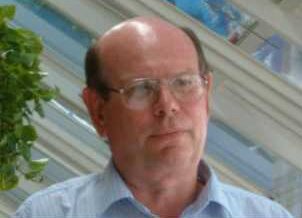
On arrival we were met by a guide who accompanied us on a bus and ferry trip to the highlands on Santa Cruz for lunch and a wander around a farm, where we saw our first tortoises, and then to the Charles Darwin Research Centre. Then we returned to the port at Santa Cruz and boarded the boat. Seas were heavy while we were moored and some passengers did not appear for dinner. The food on board was excellent; my only disappointment was the high price and limited choice of red wines. Food was included, alcohol was not. We had a new guide on the boat; the picture is of Galo, shortly after he lectured us on the need to wear good strong hiking boots when hiking in the lava.
One advantage of seeing the islands by cruise boat is that you sleep through most of the travel time. We woke many nautical miles away at Point Moreno on the far side of Isabela Island after 12 hours cruising through the night, then moved up the coast over the next couple of days to see Elisabeth Bay and Urbina Bay. Our first excursion was a walk across the sharp, new (by geological standards) lava to see tortoises, fish and flamingoes in the natural pools in the rock.


I realised during that excursion that this would be a physically demanding trip for me. The lava was sharp, sometimes loose, and always ready to cause a trip or an ankle twist. I needed to be very careful but managed to stay with the group. I turned out to be the eldest in the party, with my room-mate a close second in age but a long way ahead of me in fitness. He had spent the previous six months travelling around South America as part of an adventure bus group. This cruise is not one for the arthritic or unfit, with several long walks. On the other hand, the two young boys in the group handled it pretty easily.
I found that the three and a half weeks I had spent at high altitude in Peru and Quito helped quite a lot. I seemed to have a lot more energy and reserves now that I had returned to sea level. One final note on health; I discovered that my SPF55+ sun cream, bought in Peru, worked fine provided that I did not apply water but that it washed off instantly in the sea. The way I found out was to look in the mirror on the second morning and see a bright red stranger looking back at me. I must look up the Spanish word for “waterproof” on the label in future. Luckily I had worn a T-shirt while I swam as I didn't need a wet-suit; that had protected me from worse burns. I recall thinking that the land iguanas looked a bit nasty with various pieces of skin moulting off them; a week later I resembled an iguana.
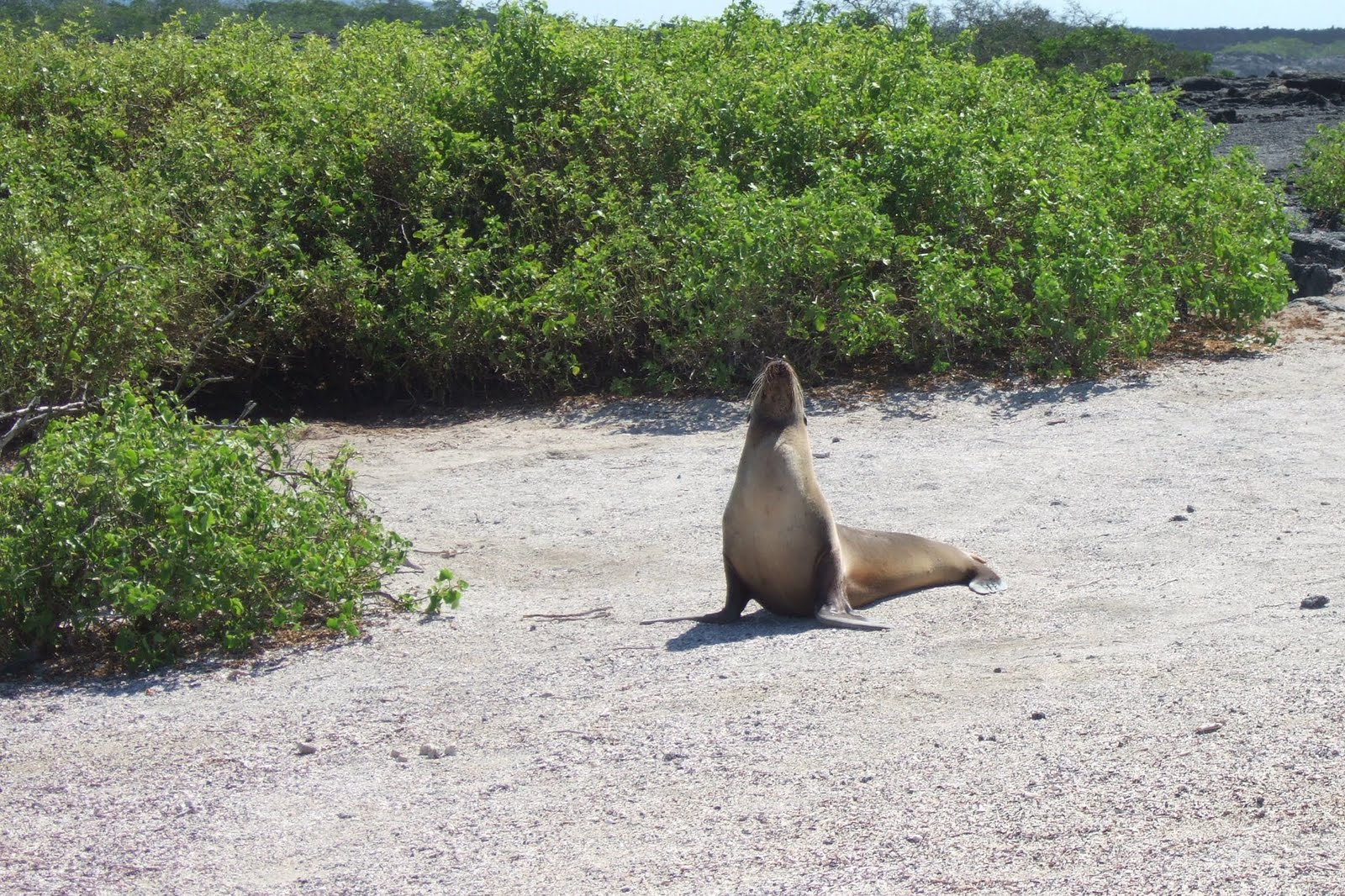
I had never snorkelled before in my life, so that was a new experience for me when we reached Elizabeth Bay. It is something I intend to continue now that I have learned how. What a wonderful place to learn in. The colours and closeness of the fish, sea-lions, penguins and other denizens of the deep were stunning. Unfortunately I did not have an underwater camera to catch the activity below the surface. During the trip I snorkelled several times. Unfortunately, I eventually found it hard to break a phobia for sharks ingrained in me as a toddler. In Australia that is an automatic reaction; in the Galapagos it didn't matter that the guide told me how harmless reef sharks are – my brain understood but my body did not. So I missed the final snorkelling session when the guide enthusiastically reported that we would definitely see more sharks that day.
Over the next three days we travelled up the west coast of Isabela, then over to Fernandina Island, back to the north-west of Isabela, then across to tiny Bartolome Island for the view from the top of the mountain and then to the Plaza Islands where I took the photos of the sea-lion climbing the cliff shown in the previous post. Our final stop was in San Cristobal to see the Interpretation Centre and depart from the second airport.


One of the best things about the Seaman II Itinerary B was the timing and locations. When we first boarded the boat we were surrounded by other cruise boats and I expected to see similar crowds wherever we went. We did not. For the first three days we rarely saw another boat except when we passed an occasional one at sea and we were always alone at our moorings and on our excursions. It was not until we reached Bartolome Island, where we climbed up the long, long ramp and stairs for the view, that we saw other boats in the same bay. Even then our guide arranged for us to rise early to beat the crowds.


The arrangement of the itinerary to give us this solitude was excellent.
In the evening as we departed Ferdinand we crossed the equator. The captain invited us to the bridge to note the event.


Every island and stop was different; I won't go into all the details because it would take much too long.


Over the course of those few short days I walked on lava and through rainforests and scrub; climbed a volcano (inactive at the moment); snorkelled; saw all of the birds and animals – and more - shown in the past few reports; glided silently on a Panga (Zodiac) through hidden waters deep in the mangroves watching turtles and wonderfully coloured rays slip quietly under us; watched hundreds of dolphins speeding and jumping in front of the boat as we cruised; and enjoyed the company of new ship-board friends.
Although the enthusiasm of our guides to imply that Darwin's theory of evolution was based solely on his experiences in the Galapagos is understandable, it should be remembered that Darwin formed his ideas over a long tour around the world which also included the fascinating flora and fauna of South America, Australia and other places. All of those places influenced his thinking, not just the Galapagos. That does not detract from the fascination of a visit to the islands.


An experience not to be missed.
Cheers, Alan